Fire Hose Reel Compliance Standards in Australia: The Complete NSW Building Owner's Guide
Fire Hose Reel Compliance Standards in Australia: The Complete NSW Building Owner's Guide
If you own or manage a commercial, industrial, or multi-residential building in Western Sydney, fire hose reel compliance standards in Australia are not something you can afford to treat as an afterthought. In my ten years of conducting fire safety inspections across Parramatta, Blacktown, Penrith, Liverpool, and beyond, I've walked through hundreds of buildings where hose reels were either completely blocked, quietly failing a flow test, or simply not being serviced to the standard the law now requires. The consequences — a blocked Annual Fire Safety Statement, council fines, voided insurance, and genuine life-safety risk — are entirely preventable. This guide breaks down exactly what the standards demand, what NSW law requires, and what I consistently see going wrong on site.
What Standards Govern Fire Hose Reels in Australia?
Understanding fire hose reel compliance in Australia starts with recognising that no single document covers everything. Compliance is not governed by a single standard, but by an interconnected ecosystem of documents. The two most critical are AS 2441-2005, which is the installation standard — dictating the technical specifics of how and where fire hose reels must be installed, covering location, mounting, water supply, and signage — and AS 1851-2012, which governs ongoing maintenance throughout the system's life.
AS 2441-2005 remains the current, reconfirmed (in 2018) standard for installation. On top of these two, there is also AS 1221, which sets the product performance requirements that a compliant hose reel assembly must meet before it can even be installed. AS 2441 is enforced through the National Construction Code, and these systems are designed to provide fast, reliable firefighting capability when it matters most.
In my professional opinion, the biggest source of confusion I see with building owners — particularly strata committees in areas like Fairfield and Cumberland — is assuming that a building compliant at the time of construction stays compliant indefinitely without intervention. That is not how the regulatory framework works. Compliance does not end at installation. Fire hose reels require ongoing maintenance to remain compliant and functional. Installation and maintenance are two separate, equally mandatory obligations under two separate standards.
AS 2441 Installation Requirements: What Every Building Must Meet
From my experience carrying out fire safety inspections across Western Sydney, the installation requirements under AS 2441 are more detailed than most building owners realise, and failing any one of them can be enough to stop an Annual Fire Safety Statement (AFSS) from being issued.
Key installation requirements include location — the reel must be easily accessible and positioned so that any part of the floor area can be reached with a 36-metre hose. The reel must be fixed to a wall or structure that can support its full weight and water pressure. A minimum dynamic pressure of 0.2 MPa must be maintained at the outlet, with backflow prevention. The hose must resist heat and abrasion, and the nozzle must deliver a solid, controllable water stream.
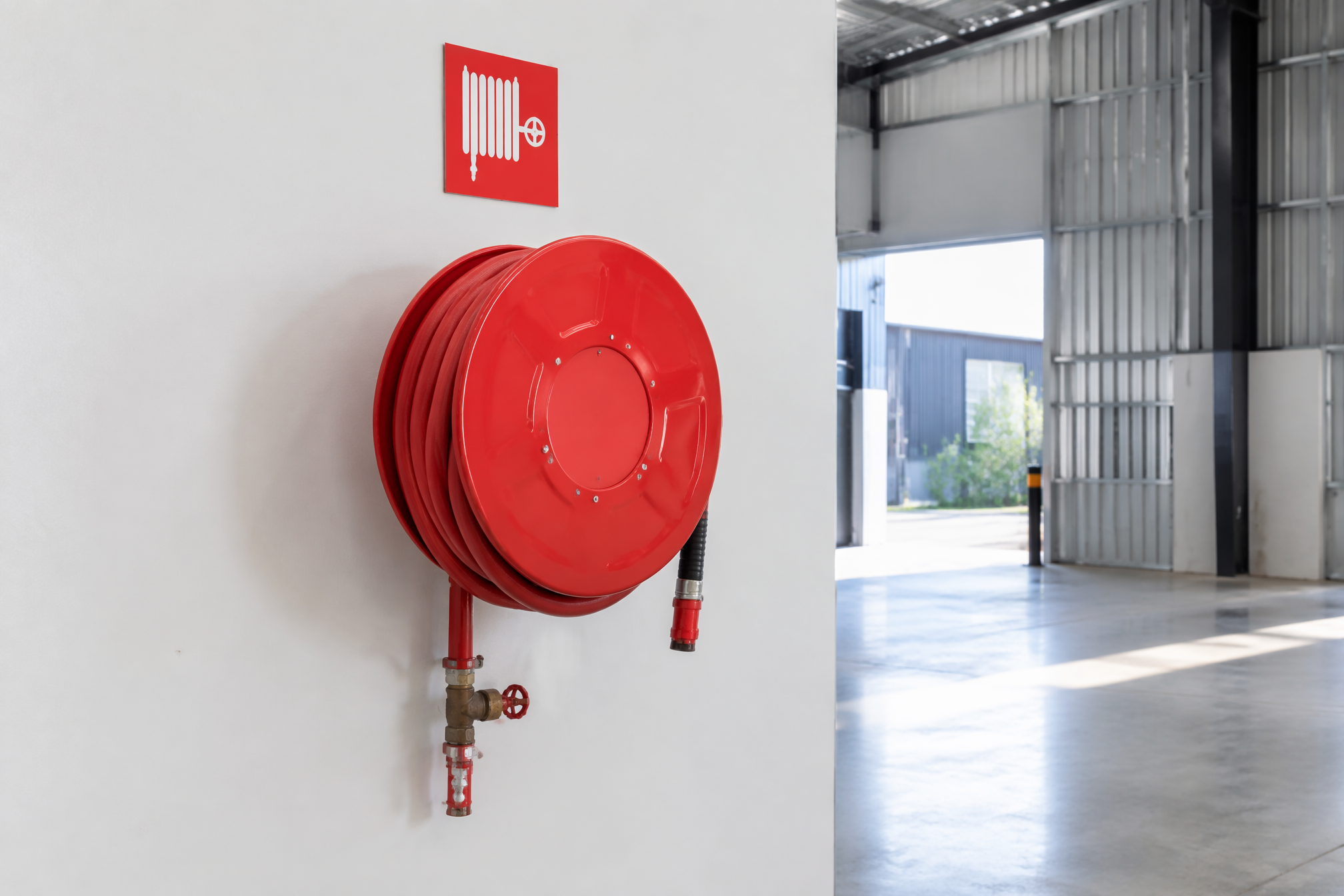
On signage, AS 2441 mandates clear signage to identify the reel's location. The location sign must feature a white pictogram (hose reel symbol) and/or text on a "Signal Red" background — specifically R13 Signal Red as defined in AS 2700. The sign must be installed directly above the fire hose reel, and the base of the sign must be no less than 2 metres from the floor, ensuring it is visible above average head height and obstructions.
I've seen brand new developments in Penrith and Blacktown pass their construction certificate and then, two years later, have hose reels obstructed by shelving units or racking that tenants have installed. Fire hose reels must be positioned so that every point on the floor can be reached with the hose stream, accounting for bends and obstacles. Even the best fire hose reel is useless if people cannot find or access it quickly, and they must never be hidden behind furniture, locked away, or blocked by stored goods. That's the kind of thing I flag immediately on inspection, because it's a critical defect under AS 1851.
AS 1851-2012 Maintenance Schedule: What Section 9 Requires
This is where building owners in NSW need to pay very close attention, particularly given a significant regulatory change that came into effect in early 2026. In key jurisdictions such as New South Wales, the previously deferred Environmental Planning and Assessment (Development Certification and Fire Safety) Amendment Regulation took full effect. From 13 February 2026, it became mandatory for all essential fire safety measures — including fire hose reels — to be maintained in strict accordance with Australian Standard AS 1851-2012: Routine service of fire protection systems and equipment. This is a fundamental shift in legal liability.
What may have previously been treated as a "best practice" guideline by some fire contractors is now a legislated requirement. Failure to adhere to the precise inspection, testing, and record-keeping protocols within AS 1851-2012 will constitute a direct regulatory breach.
AS 1851, Section 9 sets a clear, non-negotiable service schedule for all installed fire hose reels. The frequencies are: Six-Monthly (semi-annual) — a detailed visual inspection and functional check. Yearly (annual) — all six-monthly tasks plus a full hose inspection and a measured water flow test. Five-Yearly — this involves a hydrostatic pressure test of the hose itself to ensure its integrity.
In practice, fire hose reels are checked at the six-monthly mark and also at an annual test which includes a flow test. The flow test ensures that the four-metre stream that a hose reel is designed to produce works under the current water pressure provided. From my experience, buildings in older Western Sydney industrial precincts — particularly in parts of Auburn and Merrylands — often have ageing pipe infrastructure that struggles to maintain adequate pressure at the most hydraulically disadvantaged reel on the floor. That issue only shows up when you actually run the flow test, not during a cursory visual inspection.
Critically, a hard-copy logbook must stay on site after every service, and records must be kept for at least 7 years under AS 1851-2012. In NSW, only an Accredited Practitioner Fire Safety (APFS) can endorse the Annual Fire Safety Statement. This is a point I cannot stress enough to strata committees: the person signing off on your hose reel compliance must hold current APFS accreditation.
AS 1851 Service Frequency Summary: A Quick Reference
| Service Interval | Required Activities Under AS 1851, Section 9 | Who Must Perform It | Documentation Required |
|---|---|---|---|
| Six-Monthly | Visual inspection of hose, nozzle, reel drum, signage, mounting and cabinet; functional operational check; confirm unobstructed access | Competent person (licensed fire technician) | On-site logbook entry; defect report if applicable |
| Annual | All six-monthly tasks plus full hose inspection (cracks, abrasion, deformity); measured water flow test confirming minimum discharge | Competent person (licensed fire technician); APFS sign-off for AFSS | On-site logbook; flow test record; AFSS declaration |
| Five-Yearly | All annual tasks plus hydrostatic pressure test of hose assembly to verify structural integrity | Licensed fire technician with appropriate qualifications | Hydrostatic test certificate retained on site for 7 years |
The NSW Regulatory Framework: AFSS, the EP&A Regulation, and Your Legal Exposure
Fire hose reel compliance does not sit in isolation — in NSW, it is directly tied to your obligation to lodge an Annual Fire Safety Statement. Building owners of all commercial, multi-residential, retail, and industrial premises have an obligation under the Environmental Planning and Assessment (Development Certification and Fire Safety) Regulation 2021 to submit an Annual Fire Safety Statement to both Council and Fire & Rescue NSW every year.
The Environmental Planning and Assessment (Development Certification and Fire Safety) Regulation 2021 identifies that it is the responsibility of the building owner to maintain all essential fire safety measures installed in the building premises. Fire hose reels are explicitly listed as an essential fire safety measure, and the accredited practitioner must physically inspect and verify the performance of each essential fire safety measure on the schedule. This includes functional testing of fire detection and alarm systems, as well as flow and pressure testing of hydrants and hose reels.
The financial consequences of non-compliance are significant. Given the serious nature of non-compliance with fire safety requirements, substantial penalties apply for any failure to comply as provided for in the EP&A Act 1979. Proceedings for an offence may be taken before a Local Court where a maximum fine of $110,000 may be imposed, or Council may issue Penalty Notices — an incomplete statement may attract at least a $1,000 Penalty Notice, and failure to maintain an essential fire safety measure may attract an additional $6,000 Penalty Notice.
For strata buildings specifically, the Owners Corporation — not individual lot owners, and not your strata manager — is the legal entity responsible for fire safety compliance. This means the committee must ensure inspections are arranged, defects are rectified, records are kept, and the AFSS is lodged on time. In my professional opinion, this point is consistently misunderstood across strata schemes in Canterbury-Bankstown and Liverpool, where committee members genuinely believe their strata manager bears the compliance risk. They do not.
Critical Defects: What Fails a Hose Reel and Blocks Your AFSS
Under AS 1851, defects in fire hose reel systems are categorised — and the most serious category, a "critical defect," has immediate consequences for your building's compliance status. The consequence of a critical defect is severe. The fire technician cannot legally pass the system. This means the building owner cannot sign their Annual Fire Safety Statement or equivalent state-based declaration. This places the building in immediate breach of the Environmental Planning and Assessment Regulation, can void the building's fire insurance, and may attract significant penalties from the local council or fire brigade.
From my experience on site across Western Sydney, the most common critical defects I encounter are:
Hose reels completely obstructed by racking, vending machines, pallets, or building materials stored by tenants
Stop valves found closed — meaning the reel would deliver zero flow in an emergency
Hose that has perished, cracked, or deformed due to age, UV exposure, or chemical contact
Water pressure too low at the most distant reel, often due to ageing building pipework or an undersized booster pump
Signage missing, faded, or installed below the minimum 2-metre height requirement under AS 2441
No on-site logbook — or a logbook with gaps that mean the routine service history cannot be verified
Nozzle locking device missing or non-functional, preventing safe first-responder operation
Missing logbook entries, unresolved defects, expired extinguisher tags, obstructed hose reels, and inoperative emergency lights can all create problems well before the annual statement is due. A common misunderstanding in strata is that "annual certification" means "annual maintenance." That is not how fire compliance works on site. The annual certificate is the end-of-cycle declaration — the actual compliance work happens throughout the year through routine testing, defect management, logbook records, and rectification.
I was recently called into a commercial complex in Parramatta where the building's AFSS had been lodged year after year, but nobody had actually run a flow test on the hose reels in the ground-floor car park. When we tested them, two of the three reels on that level delivered well below the minimum discharge rate required under AS 1851. The annual paperwork looked fine. The reels were not.
Which Buildings Require Fire Hose Reels Under the NCC?
Compliance with AS 2441-2005 for the installation of fire hose reels is a legal obligation across Australia, primarily due to its direct incorporation and referencing within the National Construction Code (NCC)/Building Code of Australia (BCA). However, not every building is required to have them — the NCC determines whether your specific building classification and configuration triggers the requirement.
Fire hose reels are to be located within 4 metres of exits and provide coverage within the building based on a 36-metre hose length. For taller buildings, the requirements become more demanding: for buildings with an effective height greater than 12 metres, at least one fire hose reel is required for each stair, lift shaft, and central core area of the building; and fire hose reels for buildings 30 metres or more in height must be located at each floor level between the ground floor and the uppermost floor level where access to the uppermost floor level is provided by a stair, lift, or escalator.
The NCC building classification that applies to your premises — Class 2 (residential apartment), Class 5 (office), Class 6 (retail), Class 7 (warehouse), Class 8 (industrial), and so on — determines your base requirements. In my professional opinion, any building owner who is uncertain whether their building should have hose reels on the fire safety schedule should seek a compliance review before their next AFSS is due, not after a council notice arrives. Not all buildings have the same fire hose reel requirements. Australian Standards and the NCC tailor requirements based on building use and risk.
Frequently Asked Questions
How often do fire hose reels need to be serviced in NSW?
Under AS 1851-2012, which became mandatory in NSW from 13 February 2026, fire hose reels must be serviced at a minimum of every six months, with a more comprehensive annual service that includes a measured flow test, and a hydrostatic pressure test of the hose assembly every five years. Hydrant valves, fire hose reels, portable fire extinguishers, fire blankets, and emergency planning services require bi-annual assessment as a baseline, with additional requirements at the annual and five-yearly intervals. A hard-copy logbook must be left on site after every service visit, and records must be retained for at least seven years.
Who is responsible for fire hose reel compliance in a strata building?
As a general principle, if a fire safety system is on common property, it is the owners corporation's responsibility to maintain it. This covers the majority of systems in the building, including fire hose reels, fire indicator panels, sprinkler and hydrant systems, emergency and exit lighting, fire doors in common areas, and the paths of travel to exits. Individual lot owners are not responsible for common property fire safety equipment. The owners corporation — through its strata committee — must arrange inspections, manage defects, keep records, and lodge the AFSS on time.
What is a critical defect under AS 1851 and what happens if one is found?
A critical defect is one that renders the fire hose reel system inoperative — for example, a closed stop valve, a burst or perished hose, or the reel being completely blocked by an obstruction. When a critical defect is identified, the fire technician cannot legally pass the system, which means the building owner cannot sign their Annual Fire Safety Statement. The building falls into immediate breach of the EP&A Regulation 2021, potentially voiding fire insurance and attracting council penalties. Rectification must occur before the AFSS can be issued.
Can a building owner self-certify fire hose reel compliance in NSW?
No. All fire safety measures must be inspected by an Accredited Practitioner (Fire Safety) to ensure measures are being maintained to the relevant Australian Standard. An Accredited Practitioner Fire Safety (APFS) holds accreditation issued through the NSW Government's Building Professionals Board framework. This is not a role that can be fulfilled by a building manager, a general plumber, or an unaccredited fire technician. Regulation 88 of the EP&A (Development Certification and Fire Safety) Regulation 2021 also requires that the assessment and inspection supporting an AFSS be carried out within the three months immediately before the statement is issued — meaning you cannot rely on an inspection conducted six months ago.
Get Your Fire Hose Reels Compliant — Book a Fire Safe Inspection Today
Fire hose reel compliance in NSW is no longer a paperwork exercise — it is a legally enforced, schedule-driven obligation under AS 1851-2012 and the EP&A Regulation 2021, with real financial and safety consequences for building owners who fall behind. If your building is in Parramatta, Blacktown, Penrith, Liverpool, Canterbury-Bankstown, Cumberland, or Fairfield, and you are unsure whether your hose reels are meeting their six-monthly, annual, or five-yearly obligations under AS 1851 — or if you have recently received a defect notice you need cleared before your AFSS is due — now is the time to act.
Fire Safe is a Western Sydney fire safety compliance specialist. Our APFS-accredited team conducts AS 1851 routine servicing of fire hose reels and all essential fire safety measures, carries out flow and pressure testing, prepares Annual Fire Safety Statement assessments, and delivers compliance reviews for building owners and strata committees across the region. Call us today on 1300 347 372 or use the contact form on this page to book your AS 1851 routine service or AFSS inspection. Don't wait for a council notice or a failed flow test — get ahead of your compliance obligations with the team that knows Western Sydney's buildings inside and out.
Disclaimer: This article provides general information about fire safety compliance obligations in NSW and is not legal advice. Regulatory requirements may vary depending on your building's specific fire safety schedule, classification, and construction date. Always engage a licensed and APFS-accredited fire safety practitioner to assess your individual building's obligations.