What Is a Fire Safety Schedule in NSW? A Complete Guide for Building Owners and Strata Committees
What Is a Fire Safety Schedule in NSW? A Complete Guide for Building Owners in 2026
If you own or manage a commercial, industrial, or multi-residential building in Western Sydney, the term "Fire Safety Schedule" should already be part of your vocabulary — but in my experience, it often isn't. After a decade of on-site fire safety work across Parramatta, Blacktown, Penrith, and Liverpool, I can tell you that the Fire Safety Schedule is the single most misunderstood document in building compliance. Understanding what a Fire Safety Schedule in NSW actually is, what it must contain, how it connects to your Annual Fire Safety Statement, and what happens when it's wrong or missing — that's what this guide is here to explain. Get it right, and your compliance path becomes clear. Get it wrong, and you're exposed to fines, council enforcement, insurance complications, and in the worst cases, genuine life-safety risk.
Disclaimer: This article is intended for general informational purposes only. It does not constitute legal advice. Building owners should seek independent professional advice regarding their specific compliance obligations.
What Is a Fire Safety Schedule? The Legal Definition Explained
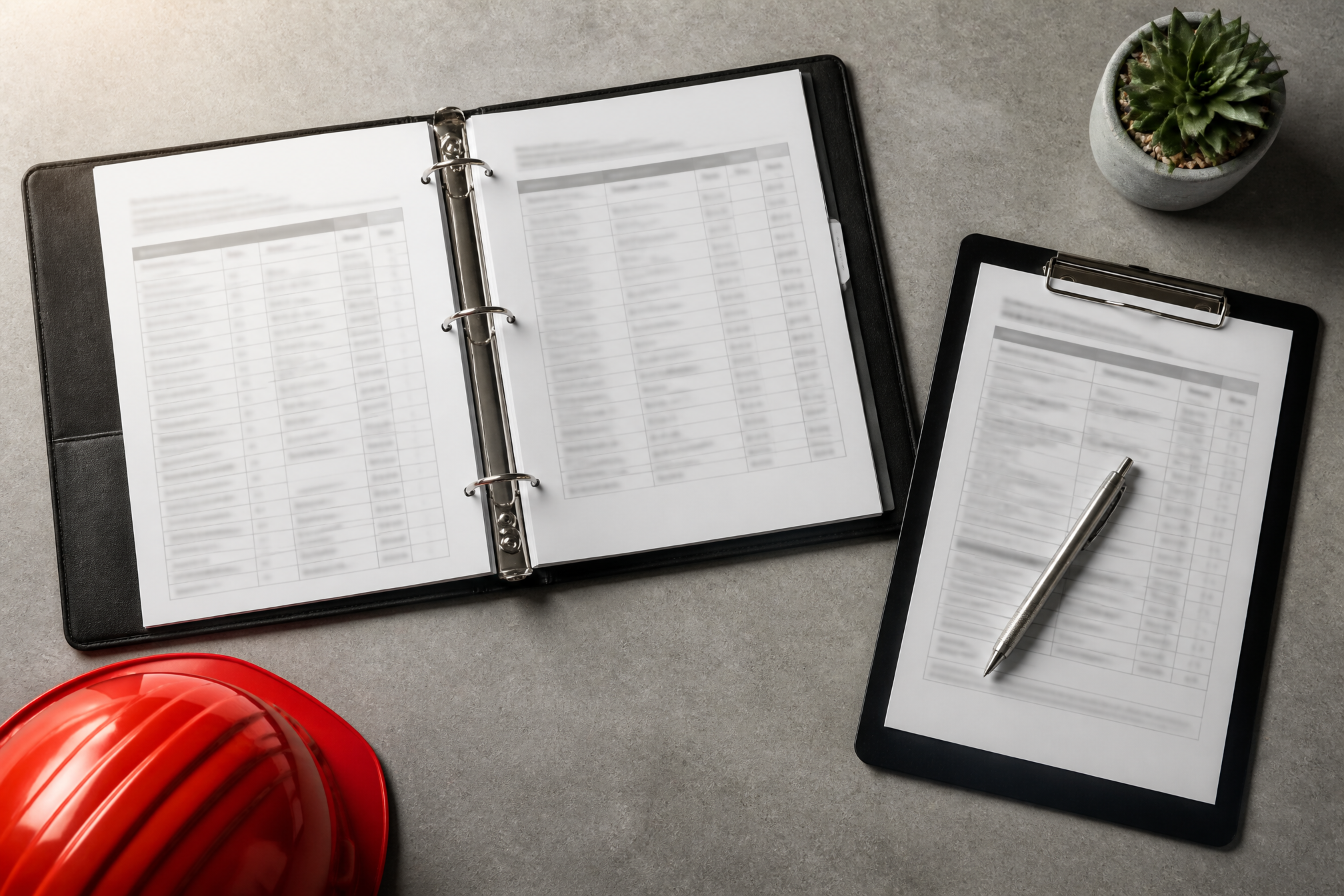
In plain terms, a Fire Safety Schedule is a legal document that lists every essential fire safety measure required to be installed and maintained in your building, along with the standard to which each measure must perform. Think of it as your building's official fire safety blueprint — not a design drawing, but a regulatory specification that travels with the property for its entire life.
The Fire Safety Schedule nominates each essential and critical fire safety measure, their standard of performance, and any performance solutions the building has. These are the benchmarks your Annual Fire Safety Statement (AFSS) will later confirm are being met.
From my experience reviewing Fire Safety Schedules across hundreds of Western Sydney properties, the measures listed typically include items such as portable extinguishers, hydrants, sprinklers, detection and alarm systems, fire doors, mechanical smoke control, emergency lighting and exit signs, and EWIS/OWS systems.
Under the legislation, a Fire Safety Schedule must specify the current and proposed fire safety measures that must be implemented for the building, including statutory fire safety measures and other fire safety measures. Critically, a Fire Safety Schedule must deal with the whole of the building and not only the part of the building to which the development consent, construction certificate, or fire safety order relates. This is a point I've seen catch building owners off guard — the schedule covers the entire structure, not just the portion being developed or altered.
The provisions governing Fire Safety Schedules sit within the Environmental Planning and Assessment (Development Certification and Fire Safety) Regulation 2021. This is your primary legislative reference for understanding your obligations.
Who Issues a Fire Safety Schedule, and When?
A Fire Safety Schedule is initially developed either by the Council or a Registered Certifier for a development at the time of issuing a building approval, construction certificate, complying development certificate, or a fire safety order, as of 1 July 1988. This means if your building was approved after mid-1988, it should have a Fire Safety Schedule on record somewhere — though in my professional opinion, "should have" and "actually does" are not always the same thing.
A Fire Safety Schedule must be issued by a council, registered certifier, or other authority when: granting development consent for a change in building use; issuing a complying development certificate for building work or a change of building use; issuing a construction certificate for building work; or giving a relevant order or accepting an undertaking in relation to the premises.
A significant regulatory improvement came into effect from 1 August 2023: a mandatory fire safety schedule template is now required for Class 1b to 9 buildings where new fire safety measures are proposed or existing measures are changed. This standardisation aims to reduce errors and omissions in fire safety documentation. Prior to this change, I regularly encountered schedules with inconsistent formatting, missing performance standards, and typographical errors that created real downstream compliance headaches for building owners at AFSS time.
It's also worth noting that a Fire Safety Schedule must specify each critical fire safety measure and the intervals, of less than 12 months, at which a supplementary fire safety statement must be given to the council for each measure, and the minimum standard of performance for each fire safety measure in the schedule. In other words, your schedule doesn't just list what systems you have — it prescribes how often certain critical systems must be formally assessed.
The Fire Safety Schedule vs the Annual Fire Safety Statement: Understanding the Difference
This is where I see the most confusion among building owners — and in my professional opinion, the distinction matters enormously. The two documents serve fundamentally different purposes and must never be conflated.
The Fire Safety Schedule says "here's what your building must have." The Annual Fire Safety Statement (AFSS) says "I've checked, and here's confirmation it's all working properly."
An Annual Fire Safety Statement is a mandatory legal declaration required under the Environmental Planning and Assessment (Development Certification and Fire Safety) Regulation 2021 for most commercial, industrial, and multi-residential buildings across New South Wales. The AFSS regime exists to confirm that every essential fire safety measure installed in a building has been inspected, tested, and assessed as capable of performing to the standard specified in the building's Fire Safety Schedule.
Under Part 12 of the Regulation, building owners must issue an AFSS every twelve months, lodge it with the local council and the Commissioner of Fire and Rescue NSW, and prominently display a copy within the building alongside the current Fire Safety Schedule.
The practical relationship between these two documents is sequential: the schedule sets the standard; the AFSS confirms that standard is being met. If a fire safety measure is present in your building but not on the schedule, or vice versa, you have a problem to resolve. I've walked into buildings in Blacktown and Cumberland LGA where the installed systems didn't match the schedule — sometimes because of legitimate upgrades that were never formally captured. Resolving that discrepancy before your AFSS is due is critical.
The following table summarises the key differences between these two documents:
| Feature | Fire Safety Schedule (FSS) | Annual Fire Safety Statement (AFSS) |
|---|---|---|
| What it is | A legal specification of every fire safety measure required in the building and its performance standard | A yearly declaration that every measure listed on the FSS has been inspected, tested, and is performing |
| Who issues it | Council or a registered certifier | The building owner or owner's agent, countersigned by an Accredited Practitioner (Fire Safety) |
| When it is issued | At development approval, construction certificate, CDC, or fire safety order | Every 12 months, lodged with council and Fire and Rescue NSW |
| Frequency | Once (or reissued if lost or amended) | Annually (plus supplementary statements for critical measures) |
| Governing legislation | EP&A (Development Certification and Fire Safety) Regulation 2021, Section 79 | EP&A (Development Certification and Fire Safety) Regulation 2021, Part 12 |
| Who must sign | Council officer or registered certifier | Building owner (or authorised agent) and an APFS-accredited practitioner |
| Display requirement | Must be displayed in a prominent location in the building | Must be displayed alongside the FSS in a prominent location |
The Role of the Accredited Practitioner (Fire Safety) — APFS
One of the most consequential regulatory changes in recent years has been the introduction of the Accredited Practitioner (Fire Safety) — commonly referred to as an APFS. A major shift in NSW legislation (fully enforced as of 2026) is the requirement for a qualified Accredited Practitioner of Fire Safety. Building owners can no longer simply have a general handyman assess or maintain the fire equipment.
The Annual Fire Safety Statement confirms that an accredited practitioner (fire safety) has assessed, inspected, and verified the performance of each fire safety measure that applies to the building. The APFS accreditation framework is administered through the Fire Protection Accreditation Scheme (FPAS) run by the Fire Protection Association Australia (fpaa.com.au). The FPA Australia's Good Practice Guide GPG-04, updated to Version 3.0 in August 2024, provides detailed industry guidance on how this process must work.
The Annual Fire Safety Statement can only be signed by the building owner or owner's agent, and not by anyone else. Although councils may or may not send reminder notices regarding statement submission, the onus is on the building owner to ensure this annual statement is submitted by the due date every year.
From my experience working with strata committees in Fairfield and Penrith, many owners corporations have been caught out assuming their managing agent or a previous contractor would handle the lodgement reminder. They didn't. The responsibility sits squarely with the building owner, and that needs to be front of mind. In a strata context, the owners' corporation is ultimately responsible for ensuring that fire safety compliance requirements, including the AFSS and Fire Safety Schedule, are met.
What Happens When Your Fire Safety Schedule Is Wrong, Lost, or Out of Date?
This is a scenario I've encountered more times than I'd like to admit. A building owner in Liverpool calls me because their AFSS practitioner has flagged that the schedule doesn't match what's installed. Or a strata committee in Parramatta has been looking for their original FSS for months and can't find it. These situations are stressful — but they're manageable if you know the correct pathway.
A building's fire safety schedule may be reissued to resolve errors or omissions — such as typographical errors, incorrect addresses, or omitted approved and installed measures — or to replace a lost or destroyed schedule, where one previously existed.
Under amendments to the Environmental Planning and Assessment (Development Certification and Fire Safety) Regulation 2021, building owners and owners corporations can approach council and request for the FSS to be reissued. Council may reissue the FSS if they are satisfied there are errors or omissions that require correction.
However, there are clear limits to this pathway. A request to reissue a fire safety schedule must not be made under this section if errors or omissions in the schedule have occurred due to building work not authorised by the applicable construction certificate or complying development certificate, or a change in plans or specifications for the fire safety measures of the building. In plain language: if the discrepancy exists because of unauthorised building work, you cannot simply request a corrected schedule — you need to resolve the underlying regulatory issue first.
From 1 August 2023, all Fire Safety Schedules must be issued using the standard template form published by the NSW Government. This requirement commenced 1 August 2023 and applies when issuing a new FSS, as well as when reissuing an existing FSS due to corrections or missing documentation.
AS 1851-2012 Is Now Mandatory: What This Means for Your Fire Safety Schedule Obligations
If there is one recent regulatory development that every Western Sydney building owner needs to understand right now, it is this: as of 13 February 2026, a major shift in NSW fire safety law is now in force. If your building is required to submit an Annual Fire Safety Statement or a Supplementary Fire Safety Statement, you are now legally required to maintain all installed essential fire safety measures in accordance with AS 1851-2012 — Routine Service of Fire Protection Systems and Equipment.
From February 13, 2026, all Class 1b and Class 2 to Class 9 buildings in NSW must have essential fire safety measures inspected, maintained, and tested in accordance with AS 1851-2012. This is not a grace period or a pilot — it is enforceable law.
The practical implications are significant. From 13 February 2026, buildings required to provide an AFSS must: maintain all installed essential fire safety measures in line with AS 1851-2012; have a documented preventative maintenance program in place; schedule routine servicing — monthly, quarterly, six-monthly, annual, five-yearly — exactly as the standard specifies; and keep full inspection, testing, and maintenance records.
Local government (Council) is the regulatory authority and has responsibility for enforcing compliance with AS 1851-2012. There are significant penalties for non-compliance, including fines of $33,000 for individuals and $66,000 for corporations.
Building owners in NSW are now required to keep maintenance records in line with AS 1851. Logbooks can be digital or hard copy, but a hard copy must be left on site at the conclusion of all routine service activities. From my professional experience, inadequate record-keeping is one of the most common causes of AFSS complications — not because the maintenance wasn't done, but because it can't be proven.
Common Mistakes Western Sydney Building Owners Make — And How to Avoid Them
After ten years of site inspections across the Western Sydney LGAs, I've seen the same compliance failures repeat themselves with near-clockwork regularity. Here's what to watch for:
Assuming the schedule is automatically up to date. Your Fire Safety Schedule is a static document. If you install a new system — upgraded sprinklers, an additional hose reel, new exit signage — those additions do not automatically appear on the schedule. They need to be formally captured through the appropriate certification pathway.
Using unqualified practitioners. A frequent issue occurs when unqualified inspectors are used to assess fire safety systems, which may result in non-compliant documentation. Post-2026, this also renders your AFSS legally invalid.
Leaving it too late. One common mistake is failing to schedule inspections early enough before the AFSS due date. Delays in inspections can make it difficult to gather certifications and submit the statement on time.
Ignoring the display requirement. The Regulation requires that a copy of the current AFSS and the current Fire Safety Schedule be displayed in a prominent location within the building, typically the main foyer or entry area. This display requirement ensures that occupants, emergency services, and council inspectors can readily verify the building's fire safety status.
Underestimating the penalties. In NSW it is an offence under the Environmental Planning and Assessment Act 1979 not to submit a compliant AFSS to council by the due date. Offences can be subject to a court-imposed penalty of up to $110,000 or an on-the-spot fine.
Failing to maintain records throughout the year. Maintaining accurate documentation is critical. Without proper records of inspections and maintenance activities, building owners may struggle to demonstrate compliance during regulatory reviews.
Frequently Asked Questions
Does every building in NSW need a Fire Safety Schedule?
Not every building is subject to fire safety scheduling requirements. Class 1a or Class 10 buildings — standard residential dwelling houses and domestic garages — are generally excluded. If you own or manage a Class 2 to Class 9 building in New South Wales, submitting an Annual Fire Safety Statement is not optional — it is a legal requirement. If you are unsure which building class applies to your property, your local council or a fire safety practitioner accredited under FPAS can assist. In Western Sydney LGAs, councils including Parramatta, Blacktown, Cumberland, Penrith, Liverpool, Canterbury-Bankstown, and Fairfield all enforce these requirements.
What measures are typically listed on a Fire Safety Schedule?
A Fire Safety Schedule lists all the fire safety measures that need to be maintained in a building to meet legal requirements. This includes elements like fire alarms, extinguishers, sprinklers, emergency lighting, and more. The exact measures listed depend on your building's class, age, construction type, occupancy, and the standards in force at the time of approval. In NSW, under the Environmental Planning and Assessment Act 1979, a building's essential fire safety measures only need to be maintained to the standard at the time of construction. However, your maintenance obligations under AS 1851-2012 apply regardless of the age of the building.
What happens if I can't find my building's Fire Safety Schedule?
If your Fire Safety Schedule has been lost, you can request a reissue from your local council under Section 80A of the EP&A (Development Certification and Fire Safety) Regulation 2021. A fire safety schedule may be reissued by a council if the schedule has been lost or destroyed, or if there are errors or omissions in the schedule requiring correction. The application process requires supporting documentation about the property. In my experience, councils in Western Sydney such as Parramatta City Council and Blacktown City Council have clear processes for this — contact their building certification or fire safety teams directly. For complex properties, engaging an APFS-accredited practitioner to prepare a fire safety audit first can greatly streamline the reissue process.
Can I submit my AFSS without an accredited fire safety practitioner (APFS)?
No — not for most buildings in NSW after the 2026 reforms. As of 2026, building owners must ensure that the person performing the assessment is an Accredited Practitioner (Fire Safety) and that all maintenance follows the AS 1851-2012 standard to avoid liability and ensure the statement is legally valid. The introduction of the requirement for building owners to engage an Accredited Practitioner (Fire Safety) to perform certain tasks has increased the accountability of the process. Verify that your practitioner holds current FPAS accreditation — the Fire Protection Association Australia (fpaa.com.au) maintains a public register of accredited practitioners you can check.
Book Your Annual Fire Safety Statement Service With Fire Safe — Serving Western Sydney
If you've read this guide and you're now looking at your fire safety documentation — or realising you can't quite put your hands on it — the next step is straightforward. Fire Safe is Western Sydney's specialist Annual Fire Safety Statement provider, serving building owners, strata committees, owners corporations, and property managers across Parramatta, Blacktown, Penrith, Liverpool, Canterbury-Bankstown, Cumberland, and Fairfield. Our team of accredited practitioners works to the full requirements of AS 1851-2012 and the EP&A (Development Certification and Fire Safety) Regulation 2021 — every inspection, every assessment, every lodgement, done properly. Whether you need a first-time AFSS lodgement, a compliance review of your current Fire Safety Schedule, or a complete AS 1851-2012 routine servicing program put in place for your building, Fire Safe can help. Call us on 1300 347 372 or use the contact form on this page to book your inspection. Don't wait for a council notice or a missed deadline — reach out to Fire Safe today and get your building compliant.