Fire Safety Schedule vs Annual Fire Safety Statement: The Difference Every NSW Building Owner Needs to Know
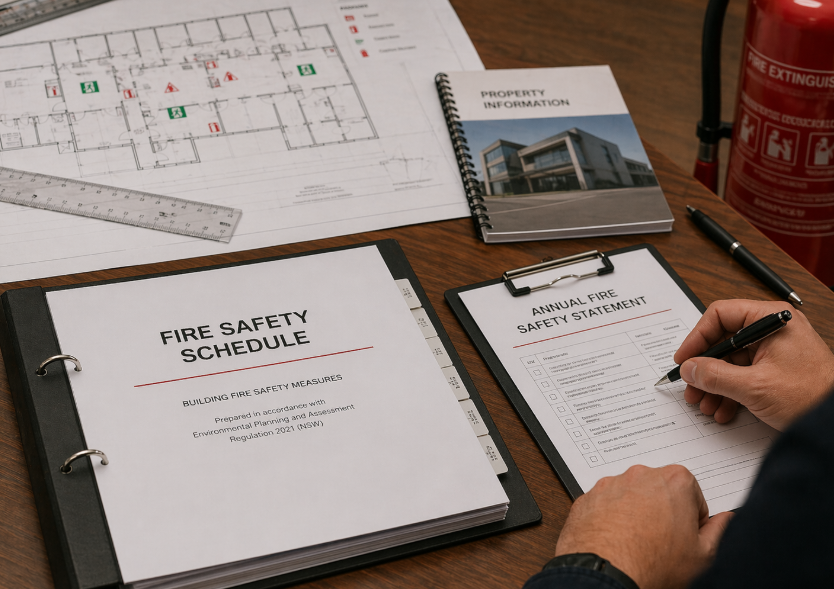
Two documents. Two jobs. Both legally required.
If you own, manage, or sit on the strata committee of a commercial, industrial or residential building in NSW, you've probably heard the terms "Fire Safety Schedule" and "Annual Fire Safety Statement" thrown around.
Many building owners assume they're the same thing. They're not.
One is the legal master list of the fire safety measures your building must have. The other is the annual declaration confirming those measures are working. You need both. And if either is wrong, missing or out of date, you're exposed to fines, insurance risk, and in serious cases, enforcement action from council or Fire & Rescue NSW.
This article explains what each document is, how they connect, who creates them, and the most common mistakes Western Sydney building owners make when dealing with them.
What is a Fire Safety Schedule (FSS)?
A Fire Safety Schedule is a legal document that lists every essential fire safety measure required to be installed and maintained in your building, along with the standard to which each measure must perform.
Think of it as the master specification for your building's fire safety setup.
A Fire Safety Schedule is typically issued by your local council (or a private certifier) as part of one of the following:
The original development approval and construction certificate for the building.
A complying development certificate for a new building or major alteration.
A Fire Safety Order issued by council requiring upgrades to an existing building.
Once the schedule is issued, it forms the enforceable baseline. Every subsequent annual compliance activity — including your AFSS — refers back to the schedule.
A typical Fire Safety Schedule lists things like:
Portable fire extinguishers (with the relevant standard, e.g. AS 2444)
Fire hydrant systems (AS 2419.1)
Fire hose reels (AS 2441)
Automatic fire sprinkler systems (AS 2118.1)
Emergency lighting and exit signs (AS 2293)
Fire doors and fire shutters (AS 1905.1)
Smoke alarms and automatic detection (AS 1670.1)
Mechanical air handling systems (AS 1668.1)
Paths of travel to exits
Exit signs
Each measure on the schedule is tied to:
The relevant Australian Standard it was installed to.
The performance standard it's required to meet.
The standard to which it must be maintained.
If a fire safety measure is present in your building but not on the schedule, or vice versa, you have a problem to resolve.
What is an Annual Fire Safety Statement (AFSS)?
An Annual Fire Safety Statement is a document the building owner must lodge with the local council and Fire & Rescue NSW every 12 months.
It's your yearly declaration — signed by a competent fire safety practitioner — that every single fire safety measure listed on your Fire Safety Schedule has been:
Inspected within the last 12 months.
Tested and found to be capable of performing to the standard required.
Maintained in accordance with AS 1851-2012 (mandatory across NSW since 13 February 2026).
In other words, the Fire Safety Schedule says "here's what your building must have." The AFSS says "I've checked, and here's confirmation it's all working properly."
Without a compliant AFSS lodged on time each year, your building is non-compliant under the Environmental Planning and Assessment Act 1979 and its associated regulations.
The relationship between the two
Here's the simplest way to visualise how these documents work together:
Your Fire Safety Schedule is the contract. It was issued when the building was approved or altered, and it sets out the exact fire safety measures required.
Your AFSS is the annual invoice of compliance against that contract. Every year you must prove the measures on the schedule are still in place and functioning.
AS 1851-2012 is the rulebook that tells the inspector (and you) exactly how each measure should be inspected and tested, and how the records must be kept.
Take any one of these out of the equation and the system breaks down:
No Fire Safety Schedule → there's no defined list of what's required → the inspector can't definitively sign off on an AFSS.
Wrong Fire Safety Schedule → the AFSS is technically accurate but based on outdated requirements → your building may still be non-compliant.
No AFSS → the building owner hasn't met annual reporting obligations → penalties and enforcement follow.
Who creates and signs each document?
This is one of the most confused points — and it matters because the wrong person signing the wrong document invalidates the whole exercise.
Fire Safety Schedule:
Issued by: The consent authority (your local council) or an accredited private certifier.
Created during: Development approval, complying development, or in response to a Fire Safety Order.
Revised by: The consent authority — typically only when the building is altered, expanded or its classification changes. Building owners cannot revise their own schedule.
Responsible for: The building owner (or owners corporation in strata). The legal obligation sits with you.
Inspection work completed by: A competent fire safety practitioner — specifically, a person who is accredited under the Fire Protection Accreditation Scheme (FPAS) for the relevant fire safety measures, or who otherwise meets the competence requirements set by NSW legislation.
Signed by: The competent fire safety practitioner after inspecting and testing each measure, and by the building owner certifying the statement.
Lodged with: Local council and Fire & Rescue NSW within 12 months of the previous AFSS (or Fire Safety Certificate, for first-time lodgement).
Displayed where: In a prominent position inside the building — typically the ground floor lobby or main entrance. This is also a legal requirement.
Common mistakes building owners make
After years of working with Western Sydney building owners across Parramatta, Blacktown, Penrith, Liverpool, Canterbury-Bankstown, Cumberland and Fairfield, we see the same preventable errors over and over.
Mistake 1: Assuming the AFSS is enough on its own.
Some owners have a current Annual Fire Safety Statement (AFSS) but have never actually seen their Fire Safety Schedule. If the schedule is outdated or missing, the AFSS may be certifying compliance against the wrong specification.
Mistake 2: Ignoring changes to the building.
If you've renovated, changed the building's use, subdivided floors, or installed new tenancies, the Fire Safety Schedule may need to be updated by council. Continuing to lodge an AFSS against an outdated schedule can expose you later if a problem is discovered.
Mistake 3: Not displaying the current AFSS prominently.
NSW regulations require the current Annual Fire Safety Statement (AFSS) to be displayed in a prominent location inside the building. An AFSS sitting in a filing cabinet in the strata manager's office doesn't meet this obligation.
Mistake 4: Using the wrong person to sign off.
The person signing off on each fire safety measure must be accredited for that specific measure type. A practitioner accredited for fire extinguishers is not automatically accredited to sign off on sprinkler systems or mechanical smoke control. Cross-checking accreditation is something councils are increasingly scrutinising.
Mistake 5: Treating the schedule and the statement as "the fire company's problem".
They're not. Both documents sit with the building owner. Your service provider helps you comply — they don't take legal responsibility for compliance. That stays with you.
How to check if your Fire Safety Schedule is current
If you've bought a building, inherited strata committee duties, or simply never checked before, here's how to verify your FSS is current and accurate:
Find the schedule. Check your building's original development consent documents, the Certificate of Occupancy, and any later Fire Safety Orders issued by council. If you can't find any of these, contact your local council's records or planning department they'll usually have copies on file.
Check the date. When was it issued? When was it last updated?
Compare the schedule to the building as it is today. Walk the building with the schedule in hand. Does every essential measure listed exist? Is there anything installed that's not on the list?
Check the referenced standards. Are the Australian Standards listed on the schedule current? (Some older schedules reference superseded standards.)
Cross-check with your most recent AFSS. Every measure listed on the schedule should appear on the AFSS.
If anything looks off, get a qualified fire safety practitioner to review it before your next AFSS is due.
What to do if your Fire Safety Schedule is wrong or missing
This is a very common issue for older buildings in Western Sydney — especially buildings that have been renovated, changed hands multiple times, or had tenancies reconfigured.
If your schedule is missing or inaccurate:
Don't try to "update" it yourself. Only the consent authority (council) can issue or amend a Fire Safety Schedule.
Engage a qualified fire safety practitioner to assess the building and prepare a proposed schedule for council's consideration.
Lodge a request with council to issue a new or updated Fire Safety Schedule — typically via a Section 10.7 planning certificate request or a formal application, depending on the specific circumstances.
Continue lodging your AFSS in the meantime. Do not let the current AFSS lapse just because the schedule is being reviewed.
This process can take weeks to months depending on council workload — so don't leave it until the week your AFSS is due.
The role of AS 1851-2012 in all of this
Since 13 February 2026, AS 1851-2012 is the mandatory standard for inspecting and testing essential fire safety measures in NSW.
That means:
The Fire Safety Schedule tells you what must be maintained.
AS 1851-2012 tells you how to maintain, inspect and test it.
The AFSS is where you certify annually that you've done so.
All three pieces need to align. If your building has been maintained to a pre-2026 practice (e.g., just annual extinguisher tags and nothing else documented), you may be compliant with the schedule in principle but not with AS 1851-2012 — which now invalidates the AFSS.
This is the trap that's catching many building owners out in 2026: the schedule hasn't changed, the AFSS template hasn't changed much, but the underlying maintenance standard has become significantly stricter.
If you haven't reviewed your maintenance practices against AS 1851-2012 since the reform took effect, now is the time.
How Fire Safe helps you handle both
Fire Safe is a Western Sydney based fire safety specialist. We help commercial building owners, strata committees and property managers manage the full compliance cycle — not just one document.
What we do:
Fire Safety Schedule reviews. We'll compare your existing schedule to your building as it is today and flag any gaps, outdated references, or changes that need to be taken to council.
AFSS inspection and lodgement. Accredited practitioner sign-off, full AS 1851-2012 compliance, records kept on site.
Liaison with council. If your schedule needs updating, we help guide the process.
Ongoing maintenance programs. Monthly, six-monthly, yearly and long-duration services under AS 1851-2012.
Automated compliance tracking. We'll remind you well before anything is due.
One provider, one logbook, one point of contact, across all your Western Sydney buildings.
Next steps
If you're not sure whether your Fire Safety Schedule matches your building, whether your last AFSS was signed off against the right specifications, or whether your maintenance is up to AS 1851-2012 standards — get it checked before it becomes a problem.
Call Fire Safe on 1300 347 372 for a no-obligation compliance review. We'll look at your current schedule, your last AFSS, and your maintenance records, and give you a clear written picture of where you stand.
Or fill out the contact form on this page and we'll be in touch within one business day.
Your building deserves proper compliance. Let's make it easy.
This article is general information and not legal advice. For advice specific to your building or circumstances, contact Fire Safe on 1300 347 372 or consult a qualified fire safety practitioner and your solicitor.
If you own, manage, or sit on the strata committee of a commercial, industrial or residential building in NSW, you've probably heard the terms "Fire Safety Schedule" and "Annual Fire Safety Statement" thrown around.
Many building owners assume they're the same thing. They're not.
One is the legal master list of the fire safety measures your building must have. The other is the annual declaration confirming those measures are working. You need both. And if either is wrong, missing or out of date, you're exposed to fines, insurance risk, and in serious cases, enforcement action from council or Fire & Rescue NSW.
This article explains what each document is, how they connect, who creates them, and the most common mistakes Western Sydney building owners make when dealing with them.
What is a Fire Safety Schedule (FSS)?
A Fire Safety Schedule is a legal document that lists every essential fire safety measure required to be installed and maintained in your building, along with the standard to which each measure must perform.
Think of it as the master specification for your building's fire safety setup.
A Fire Safety Schedule is typically issued by your local council (or a private certifier) as part of one of the following:
The original development approval and construction certificate for the building.
A complying development certificate for a new building or major alteration.
A Fire Safety Order issued by council requiring upgrades to an existing building.
Once the schedule is issued, it forms the enforceable baseline. Every subsequent annual compliance activity — including your AFSS — refers back to the schedule.
A typical Fire Safety Schedule lists things like:
Portable fire extinguishers (with the relevant standard, e.g. AS 2444)
Fire hydrant systems (AS 2419.1)
Fire hose reels (AS 2441)
Automatic fire sprinkler systems (AS 2118.1)
Emergency lighting and exit signs (AS 2293)
Fire doors and fire shutters (AS 1905.1)
Smoke alarms and automatic detection (AS 1670.1)
Mechanical air handling systems (AS 1668.1)
Paths of travel to exits
Exit signs
Each measure on the schedule is tied to:
The relevant Australian Standard it was installed to.
The performance standard it's required to meet.
The standard to which it must be maintained.
If a fire safety measure is present in your building but not on the schedule, or vice versa, you have a problem to resolve.
What is an Annual Fire Safety Statement (AFSS)?
An Annual Fire Safety Statement is a document the building owner must lodge with the local council and Fire & Rescue NSW every 12 months.
It's your yearly declaration — signed by a competent fire safety practitioner — that every single fire safety measure listed on your Fire Safety Schedule has been:
Inspected within the last 12 months.
Tested and found to be capable of performing to the standard required.
Maintained in accordance with AS 1851-2012 (mandatory across NSW since 13 February 2026).
In other words, the Fire Safety Schedule says "here's what your building must have." The AFSS says "I've checked, and here's confirmation it's all working properly."
Without a compliant AFSS lodged on time each year, your building is non-compliant under the Environmental Planning and Assessment Act 1979 and its associated regulations.
The relationship between the two
Here's the simplest way to visualise how these documents work together:
Your Fire Safety Schedule is the contract. It was issued when the building was approved or altered, and it sets out the exact fire safety measures required.
Your AFSS is the annual invoice of compliance against that contract. Every year you must prove the measures on the schedule are still in place and functioning.
AS 1851-2012 is the rulebook that tells the inspector (and you) exactly how each measure should be inspected and tested, and how the records must be kept.
Take any one of these out of the equation and the system breaks down:
No Fire Safety Schedule → there's no defined list of what's required → the inspector can't definitively sign off on an AFSS.
Wrong Fire Safety Schedule → the AFSS is technically accurate but based on outdated requirements → your building may still be non-compliant.
No AFSS → the building owner hasn't met annual reporting obligations → penalties and enforcement follow.
Who creates and signs each document?
This is one of the most confused points — and it matters because the wrong person signing the wrong document invalidates the whole exercise.
Fire Safety Schedule:
Issued by: The consent authority (your local council) or an accredited private certifier.
Created during: Development approval, complying development, or in response to a Fire Safety Order.
Revised by: The consent authority — typically only when the building is altered, expanded or its classification changes. Building owners cannot revise their own schedule.
Responsible for: The building owner (or owners corporation in strata). The legal obligation sits with you.
Inspection work completed by: A competent fire safety practitioner — specifically, a person who is accredited under the Fire Protection Accreditation Scheme (FPAS) for the relevant fire safety measures, or who otherwise meets the competence requirements set by NSW legislation.
Signed by: The competent fire safety practitioner after inspecting and testing each measure, and by the building owner certifying the statement.
Lodged with: Local council and Fire & Rescue NSW within 12 months of the previous AFSS (or Fire Safety Certificate, for first-time lodgement).
Displayed where: In a prominent position inside the building — typically the ground floor lobby or main entrance. This is also a legal requirement.
Common mistakes building owners make
After years of working with Western Sydney building owners across Parramatta, Blacktown, Penrith, Liverpool, Canterbury-Bankstown, Cumberland and Fairfield, we see the same preventable errors over and over.
Mistake 1: Assuming the AFSS is enough on its own.
Some owners have a current AFSS but have never actually seen their Fire Safety Schedule. If the schedule is outdated or missing, the AFSS may be certifying compliance against the wrong specification.
Mistake 2: Ignoring changes to the building.
If you've renovated, changed the building's use, subdivided floors, or installed new tenancies, the Fire Safety Schedule may need to be updated by council. Continuing to lodge an AFSS against an outdated schedule can expose you later if a problem is discovered.
Mistake 3: Not displaying the current AFSS prominently.
NSW regulations require the current AFSS to be displayed in a prominent location inside the building. An AFSS sitting in a filing cabinet in the strata manager's office doesn't meet this obligation.
Mistake 4: Using the wrong person to sign off.
The person signing off on each fire safety measure must be accredited for that specific measure type. A practitioner accredited for fire extinguishers is not automatically accredited to sign off on sprinkler systems or mechanical smoke control. Cross-checking accreditation is something councils are increasingly scrutinising.
Mistake 5: Treating the schedule and the statement as "the fire company's problem".
They're not. Both documents sit with the building owner. Your service provider helps you comply — they don't take legal responsibility for compliance. That stays with you.
How to check if your Fire Safety Schedule is current
If you've bought a building, inherited strata committee duties, or simply never checked before, here's how to verify your FSS is current and accurate:
Find the schedule. Check your building's original development consent documents, the Certificate of Occupancy, and any later Fire Safety Orders issued by council. If you can't find any of these, contact your local council's records or planning department — they'll usually have copies on file.
Check the date. When was it issued? When was it last updated?
Compare the schedule to the building as it is today. Walk the building with the schedule in hand. Does every essential measure listed exist? Is there anything installed that's not on the list?
Check the referenced standards. Are the Australian Standards listed on the schedule current? (Some older schedules reference superseded standards.)
Cross-check with your most recent AFSS. Every measure listed on the schedule should appear on the AFSS.
If anything looks off, get a qualified fire safety practitioner to review it before your next AFSS is due.
What to do if your Fire Safety Schedule is wrong or missing
This is a very common issue for older buildings in Western Sydney — especially buildings that have been renovated, changed hands multiple times, or had tenancies reconfigured.
If your schedule is missing or inaccurate:
Don't try to "update" it yourself. Only the consent authority (council) can issue or amend a Fire Safety Schedule.
Engage a qualified fire safety practitioner to assess the building and prepare a proposed schedule for council's consideration.
Lodge a request with council to issue a new or updated Fire Safety Schedule — typically via a Section 10.7 planning certificate request or a formal application, depending on the specific circumstances.
Continue lodging your AFSS in the meantime. Do not let the current AFSS lapse just because the schedule is being reviewed.
This process can take weeks to months depending on council workload — so don't leave it until the week your AFSS is due.
The role of AS 1851-2012 in all of this
Since 13 February 2026, AS 1851-2012 is the mandatory standard for inspecting and testing essential fire safety measures in NSW.
That means:
The Fire Safety Schedule tells you what must be maintained.
AS 1851-2012 tells you how to maintain, inspect and test it.
The AFSS is where you certify annually that you've done so.
All three pieces need to align. If your building has been maintained to a pre-2026 practice (e.g., just annual extinguisher tags and nothing else documented), you may be compliant with the schedule in principle but not with AS 1851-2012 — which now invalidates the AFSS.
This is the trap that's catching many building owners out in 2026: the schedule hasn't changed, the AFSS template hasn't changed much, but the underlying maintenance standard has become significantly stricter.
If you haven't reviewed your maintenance practices against AS 1851-2012 since the reform took effect, now is the time.
How Fire Safe helps you handle both
Fire Safe is a Western Sydney based fire safety specialist. We help commercial building owners, strata committees and property managers manage the full compliance cycle — not just one document.
What we do:
Fire Safety Schedule reviews. We'll compare your existing schedule to your building as it is today and flag any gaps, outdated references, or changes that need to be taken to council.
AFSS inspection and lodgement. Accredited practitioner sign-off, full AS 1851-2012 compliance, records kept on site.
Liaison with council. If your schedule needs updating, we help guide the process.
Ongoing maintenance programs. Monthly, six-monthly, yearly and long-duration services under AS 1851-2012.
Automated compliance tracking. We'll remind you well before anything is due.
One provider, one logbook, one point of contact, across all your Western Sydney buildings.
Next steps
If you're not sure whether your Fire Safety Schedule matches your building, whether your last AFSS was signed off against the right specifications, or whether your maintenance is up to AS 1851-2012 standards — get it checked before it becomes a problem.
Call Fire Safe on 1300 347 372 for a no-obligation compliance review. We'll look at your current schedule, your last AFSS, and your maintenance records, and give you a clear written picture of where you stand.
Or fill out the contact form on this page and we'll be in touch within one business day.
Your building deserves proper compliance. Let's make it easy.
This article is general information and not legal advice. For advice specific to your building or circumstances, contact Fire Safe on 1300 347 372 or consult a qualified fire safety practitioner and your solicitor.