Fire Damper Inspection in NSW: The Complete Compliance Guide for Building Owners and Strata Committees
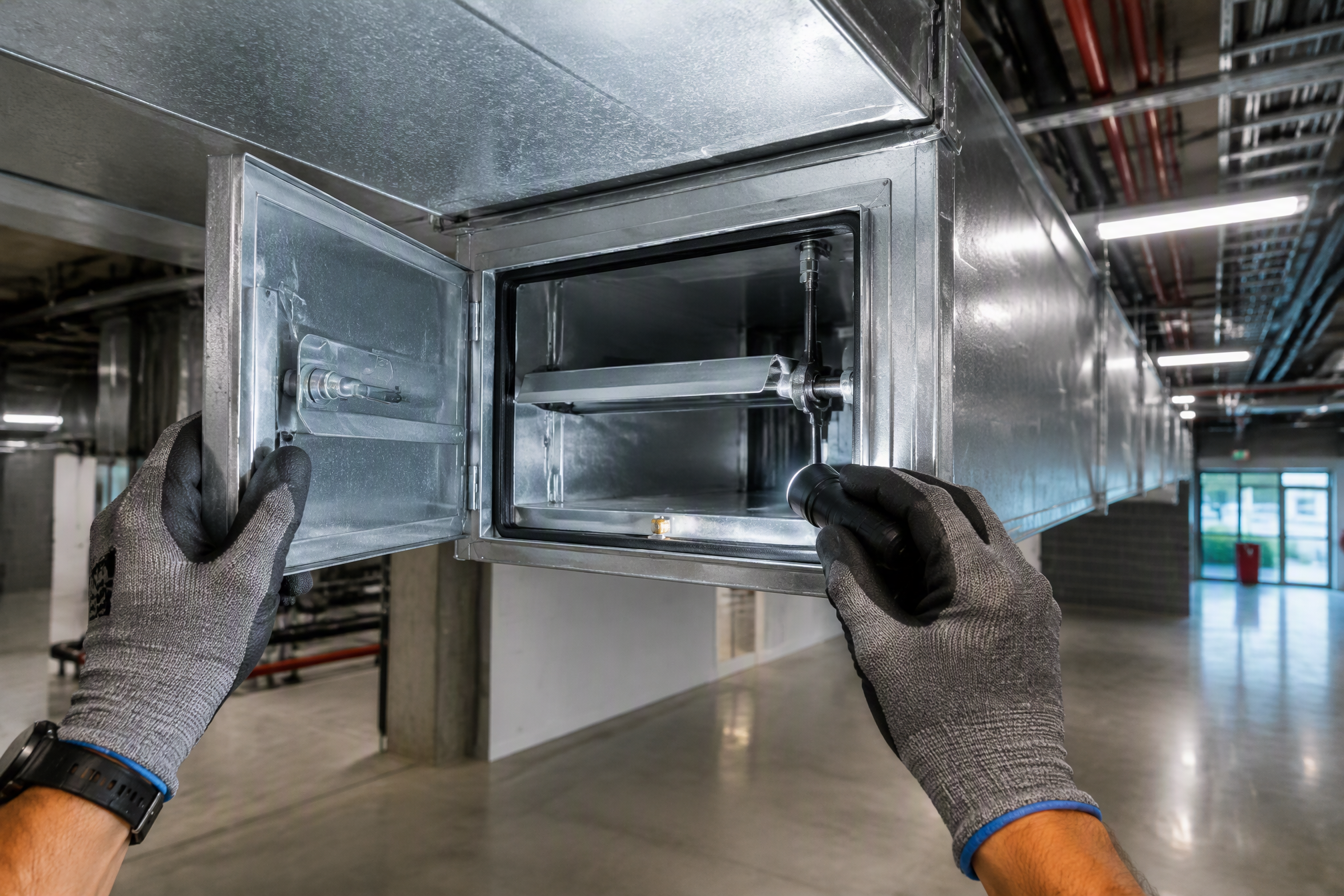
Fire damper inspection in NSW is one of the most technically misunderstood obligations in building compliance — and from my experience working across commercial, strata, and industrial properties throughout Western Sydney, it is also one of the most frequently overlooked. A fire damper is a passive device that sits silently inside your HVAC ductwork. It does nothing visible, day to day, until the moment a fire spreads through your building's ventilation system — and then its entire purpose is to slam shut and stop that spread. A fire damper is a passive fire protection device installed inside HVAC ductwork where it passes through fire-rated walls or floors, and its purpose is to automatically close when high heat is detected, preventing fire from spreading through the duct system to other parts of the building. Get the maintenance wrong, and that critical moment of protection never comes. This guide explains exactly what NSW law requires, what the Australian Standards prescribe, and what building owners in Western Sydney need to do right now to stay compliant.
Why Fire Dampers Are a Legal Essential Fire Safety Measure in NSW
In professional opinion, the single biggest conceptual mistake I see building owners and strata committees make is treating fire dampers as a purely mechanical or HVAC issue — something the air conditioning contractor handles as an afterthought. That misunderstanding can be extremely costly. Under NSW law, fire dampers are classified as essential fire safety measures (EFSMs), which means their maintenance is a legal obligation, not an optional service.
Building owners must maintain their essential fire safety measures to the standard at which they were originally installed, as set out in the Environmental Planning and Assessment Regulation 2021 (EP&A Regulation). This obligation extends to every fire damper listed on your building's Fire Safety Schedule. Buildings with essential fire safety measures listed on their Fire Safety Schedule must submit an Annual Fire Safety Statement (AFSS) to their local council and NSW Fire and Rescue each year, and the AFSS declares that each listed measure has been assessed by a properly qualified person and found to be operating to the standard required by its design specification.
Passive fire elements — fire doors, fire-rated walls, penetration seals, and dampers — are routinely listed as essential services. That means your fire dampers are almost certainly on your Fire Safety Schedule right now, and if they are not being properly inspected, tested, and documented in accordance with the relevant standards, your AFSS is at risk and so is your building's occupancy status. Failure to comply can result in penalty notices, prosecution, and even orders to vacate unsafe premises.
The Australian Standards That Govern Fire Damper Inspection
Understanding the regulatory framework is essential before engaging any fire safety practitioner to inspect your dampers. Several Australian Standards intersect here, and I have seen building owners caught off guard when a practitioner quotes one standard but the building's Fire Safety Schedule references another.
The AS 1682 series — specifically AS 1682.1 (Design and testing) and AS 1682.2 (Installation, commissioning and maintenance) — sets the rules for the manufacture, design, and installation of fire and smoke dampers. AS 1668.1 (fire and smoke control in buildings) governs the broader mechanical ventilation and smoke control framework. For ongoing maintenance and inspection, the governing document is AS 1851-2012, Routine Service of Fire Protection Systems and Equipment. AS 1851-2012 is the Australian Standard that sets out the routine servicing requirements for fire protection systems and equipment.
From my experience reviewing compliance documentation across Parramatta, Blacktown, and Penrith buildings, the most commonly referenced section for dampers is Clause 13.4.1.4. AS 1851 specifies that fire and smoke dampers must be inspected on a routine cycle, and Clause 13.4.1.4 sets out the specific requirements for routine service and inspection of dampers. Additionally, according to AS 1851, all fusible links must be replaced every 20 years. The installation standards themselves — AS 1682.1:2015 for design and testing and AS 1682.2:2015 for installation and commissioning — also apply when rectification work is carried out on defective dampers. If you are dealing with an older building that pre-dates these standards, do not assume the dampers are exempt: fire damper inspections may be applied to fire systems and equipment regardless of building age, and the systems have to perform at least at the minimum level stated in the Australian Standards.
The 20% Rolling Inspection Cycle Explained — And the Trigger for Full Building Inspections
This is the area where I most frequently encounter confusion — and genuine non-compliance — among building managers across Western Sydney's mixed-use and high-density residential stock. Many assume that "annual inspection" means every single damper is inspected once per year. In practice, AS 1851-2012 operates on a rolling cycle.
AS 1851 requires that 20% of fire dampers be inspected and tested every year, with all dampers to be tested and inspected in a five-year period. In plain terms: if your building has 50 fire dampers, you need at least 10 inspected and tested each year, with a different cohort of dampers selected each year, so that by the end of year five, every damper has been assessed.
Here is where it gets critical: there is a built-in escalation clause. If a significant number of dampers — between 10 and 20 percent — fail any inspection, all the dampers in that particular building must be inspected within the next twelve months. I have personally seen this trigger activated in older Liverpool and Cumberland warehouse conversions where decades of renovations had left dampers corroded, obstructed, or entirely inaccessible. Inaccessible dampers are a common cause of failed audits and expensive retrofit works. By the time the mandatory full inspection was triggered, the rectification bill was substantial. Early engagement and systematic 20% sampling avoids this outcome.
AS 1851-2012 Became Mandatory in NSW — What Changed in February 2026
A significant regulatory shift occurred that every building owner and strata committee in NSW needs to understand. From 13 February 2026, AS 1851-2012 became mandatory for NSW buildings under the Environmental Planning and Assessment Regulation 2021. Prior to this, AS 1851-2012 was considered best practice but was not explicitly mandated by regulation for all building classes.
If you own or manage a Class 1b or Class 2–9 building in NSW, you must ensure essential fire safety measures are inspected, tested, and maintained in accordance with AS 1851-2012. This captures everything from a two-storey boarding house in Fairfield to a mixed-use tower in Parramatta CBD. From 13 February 2026, compliance is no longer optional best practice — it is enforceable law in NSW.
The penalty exposure is real. Penalties under the EP&A Regulation 2021 escalate quickly, and knowingly making a false or misleading AFSS is a serious offence that can attract substantial financial penalties. From my professional experience, insurers are also tightening their scrutiny. Fire maintenance isn't just about ticking a compliance box — it's a critical insurance requirement, and most commercial and strata policies in NSW require proof of regular servicing in line with Australian Standards.
Who Is Qualified to Inspect Fire Dampers in NSW?
This is a question I am asked constantly by strata committees and facility managers, and the answer matters enormously because engaging an unqualified person to certify your AFSS exposes you to serious legal liability. In NSW, the accreditation requirements for fire safety assessment are specific.
In NSW, only an Accredited Practitioner (Fire Safety) — commonly referred to as an APFS — can endorse the Annual Fire Safety Statement under the EP&A Regulation 2021. For fire damper inspection specifically, technical competence requirements are defined in the standards themselves. Appendix H of AS 1851 specifies the skills required to perform the routine service of fire dampers, including testing and recording, and requires being a mechanical engineer or having five years of relevant experience coupled with a working understanding of the applicable Australian Standards and the National Construction Code.
In November 2023, the Fire Protection Association Australia (FPA Australia) received formal approval from the NSW Department of Customer Service for a revised competency pathway. On 9 November 2023, FPA Australia received formal approval for a Certificate III Pathway for the four mechanical fire safety assessment measures, encompassing fire dampers, smoke dampers, smoke and heat vents, and mechanical air handling, as a result of collaborative efforts with the air-conditioning and mechanical industry. The practical takeaway for building owners: do not accept a damper inspection report from a practitioner who cannot demonstrate appropriate APFS accreditation and relevant technical qualifications. Always ask to sight credentials before works commence.
Common Fire Damper Compliance Failures I Have Seen in Western Sydney Buildings
After inspecting and reviewing compliance documentation across Blacktown, Penrith, Canterbury-Bankstown, and Cumberland LGAs, a pattern of recurring defects emerges. These are not hypothetical risks — they are failures I have encountered repeatedly in the field, often in buildings that believed they were fully compliant.
Inaccessible dampers: Fit-out works, false ceilings, and duct modifications — common in Western Sydney's high-turnover commercial tenancies — frequently cover access panels, making testing physically impossible. Renovations, ceiling work, or duct modifications often cover access panels, making testing impossible.
Failed fusible links: Heat, humidity, and the Western Sydney climate (particularly in industrial areas around Wetherill Park and Eastern Creek where ambient temperatures in plant rooms can be extreme) accelerate fusible link degradation well before the 20-year replacement threshold.
Corrosion of damper blades and frames: The corrosion of angles around the damper requires special attention during routine service. Buildings near Liverpool and Fairfield with older mechanical systems and poor ventilation are particularly susceptible.
Incorrect installation: Incorrect placement or lack of proper clearance can prevent dampers from closing fully, which means the damper appears present on documentation but will not perform its life-safety function in an actual fire event.
Missing or incomplete paperwork: A large portion of audit failures in strata buildings comes from incomplete or inconsistent paperwork rather than physical defects, with auditors needing to see clear evidence that passive fire systems were installed correctly and maintained in line with the Building Code of Australia and relevant standards.
Non-operational dampers listed as compliant: Critical defects — such as a non-operational fire damper — must be prioritised immediately, as the AFSS cannot be signed off until these are resolved.
In my professional opinion, the most dangerous scenario is a building that has been submitting AFSS documentation year after year with dampers listed as "compliant" — without any qualified practitioner having physically tested them. This is far more common than the industry likes to admit, and it is exactly the kind of liability exposure that keeps building owners awake at night once they understand what they have signed.
Fire Damper Inspection Compliance Summary Table
To help building owners, strata committees, and property managers understand their obligations at a glance, the following table summarises the key requirements under AS 1851-2012 as they apply to fire and smoke dampers in NSW Class 2–9 buildings.
| Requirement | What It Means | Governing Standard / Regulation | Consequence of Non-Compliance |
|---|---|---|---|
| Annual rolling inspection (20% per year) | At least 20% of all fire and smoke dampers must be physically inspected and tested each year on a rotating basis across a 5-year cycle | AS 1851-2012, Cl 13.4.1.4 | AFSS cannot be endorsed; potential council fine or Fire Safety Order |
| Full building inspection trigger | If 10–20% or more of sampled dampers fail, all dampers in the building must be inspected within 12 months | AS 1851-2012, Cl 13.4.1.4 | Mandatory rectification at building owner's expense; occupancy at risk |
| Fusible link replacement | All fusible links must be replaced at the 20-year mark regardless of apparent condition | AS 1851-2012 | Non-functional damper; AFSS endorsement refused |
| Record keeping | Hard-copy logbook must remain on site after every service visit; records kept for a minimum of 7 years | AS 1851-2012, Section 1 | Audit failure; penalties under EP&A Regulation 2021 |
| Qualified inspector | Inspection and certification must be carried out by an APFS-accredited practitioner with relevant mechanical fire safety competency | EP&A Regulation 2021; AS 1851-2012, Appendix H | AFSS legally invalid; personal liability for building owner |
| Mandatory AS 1851-2012 compliance | All Class 1b and Class 2–9 buildings in NSW must maintain fire safety measures in accordance with AS 1851-2012 | EP&A Regulation 2021 (mandatory from 13 February 2026) | Significant financial penalties; risk to occupancy status |
| AFSS submission | Annual Fire Safety Statement must be submitted to local council and Fire and Rescue NSW each year, covering all listed essential fire safety measures including dampers | EP&A Regulation 2021 | Weekly penalty accumulation until lodged |
How Fire Damper Inspections Feed Into Your Annual Fire Safety Statement
From a practical compliatnce standpoint, fire damper inspections are not a standalone obligation — they are directly connected to the AFSS process that governs your building's legal status every year. Understanding this connection is essential for budgeting, scheduling, and risk management.
Adhering to AS 1851 ensures compliance with local regulations and fire safety laws, and it is a requirement for a signed AFSS by an accredited practitioner that fire systems installed be regularly inspected and tested. The AFSS, when signed, is a legal declaration. Under NSW planning regulations, an annual fire safety statement must certify that each essential fire safety measure in the building has been assessed by a competent fire safety practitioner and, as found when it was assessed, to be capable of performing to a standard no less than that specified in the fire safety schedule.
This is a higher standard than simply completing a maintenance routine. A practitioner who has performed an AS 1851 service schedule but has not actually verified that each damper is capable of performing to its specification has not completed the full legal obligation. The standard emphasises the importance of maintaining accurate records of inspections, tests, and maintenance activities, which serves as evidence of compliance and helps track the performance of fire protection systems over time. For building owners across Canterbury-Bankstown, Fairfield, and Parramatta who are managing older commercial stock or strata complexes with mixed heritage HVAC systems, this distinction between routine servicing and full AFSS assessment is something I urge you to discuss explicitly with your fire safety practitioner before any works are engaged.
Frequently Asked Questions
How often do fire dampers need to be inspected in NSW?
AS 1851 requires that 20% of fire dampers be inspected and tested every year, with all dampers to be tested and inspected across a five-year period. This means that in any given year, at least one-fifth of your building's total fire damper count must be physically tested and the results recorded. Every damper in the building must have been inspected at least once by the end of the five-year cycle. If a significant failure rate is detected during the annual 20% sample, the obligation escalates: if 10–20% or more of dampers fail any inspection, all the dampers in that particular building must be inspected within the next twelve months.
Are fire dampers an essential fire safety measure under NSW law?
Yes. Fire dampers are classified as essential fire safety measures (EFSMs) under the Environmental Planning and Assessment Regulation 2021. Building owners must maintain their essential fire safety measures to the standard at which they were originally installed, as set out in the EP&A Regulation. If fire dampers appear on your building's Fire Safety Schedule — and they almost certainly do if your building has mechanical air-handling systems — then your obligation to inspect, test, and certify them is legally enforceable. Local councils and NSW Fire and Rescue have statutory powers to issue Fire Safety Orders requiring building owners to carry out fire safety works, provide a fire safety report, or undertake other actions.
What happens if fire dampers are found to be non-compliant?
Critical defects — such as a non-operational fire damper — must be prioritised immediately, as the AFSS cannot be signed off until these are resolved. In practice, this means your AFSS is blocked, your building may be subject to a council Fire Safety Order, and your insurer may treat the non-compliance as a basis to reject claims arising from a fire incident. Non-compliance can lead to on-the-spot fines from council, court prosecution for severe breaches, and refusal to issue an Occupation Certificate for new builds. The rectification cost for failed dampers varies depending on accessibility, the extent of corrosion or mechanical failure, and whether replacement parts can be sourced for older installations. The key point is that acting early — maintaining the 20% rolling inspection schedule — almost always costs far less than responding to a triggered full-building inspection.
Do fire damper inspection requirements apply to older buildings in Western Sydney?
Yes. Fire damper inspections may be applied to fire systems and equipment regardless of building age, and the systems have to perform at least at the minimum level stated in the Australian Standards. Many of Western Sydney's commercial and mixed-use buildings in Parramatta, Blacktown, Liverpool, and Cumberland were constructed during periods when installation and documentation standards were less rigorous than today. From my experience, older buildings in these LGAs often carry the highest risk of undocumented or inaccessible dampers. For buildings that have never had a passive fire audit, the results can be confronting — but every defect that's found and fixed is a pathway for fire that's been closed. If your building has not had a comprehensive passive fire audit that includes damper mapping and condition assessment, that is the logical first step.
Disclaimer: This article is intended for general informational purposes only. It does not constitute legal advice. Building owners, strata committees, and property managers should seek independent professional advice regarding their specific compliance obligations under the Environmental Planning and Assessment Regulation 2021, AS 1851-2012, and any applicable Australian Standards. Requirements may vary depending on building class, Fire Safety Schedule conditions, and the specifics of installed systems.
Book Your Fire Damper Compliance Inspection with Fire Safe Today
If you manage a commercial building, strata complex, or industrial facility anywhere across Western Sydney — including Parramatta, Blacktown, Penrith, Liverpool, Canterbury-Bankstown, Cumberland, or Fairfield — and you are not confident that your fire damper inspection obligations under AS 1851-2012 are being met, now is the time to act. With AS 1851-2012 now mandatory in NSW from 13 February 2026, the regulatory risk of inaction has never been higher.
Fire Safe is Western Sydney's specialist fire safety compliance provider. Our Accredited Practitioner Fire Safety (APFS) team delivers AS 1851 routine servicing, fire damper inspection and assessment, and the full Annual Fire Safety Statement inspection and certification process — giving you compliant documentation and genuine peace of mind. We know the building stock, the local councils, and the compliance landscape across every LGA in the region. Call us on 1300 347 372 or use the contact form on this page to book your Annual Fire Safety Statement inspection or AS 1851 fire damper compliance review. Don't wait for a council Fire Safety Order or a blocked AFSS to force the issue — contact Fire Safe today and get your building compliant.