Commercial Building Fire Safety Inspection Checklist: What Assessors Really Look For During Your AFSS
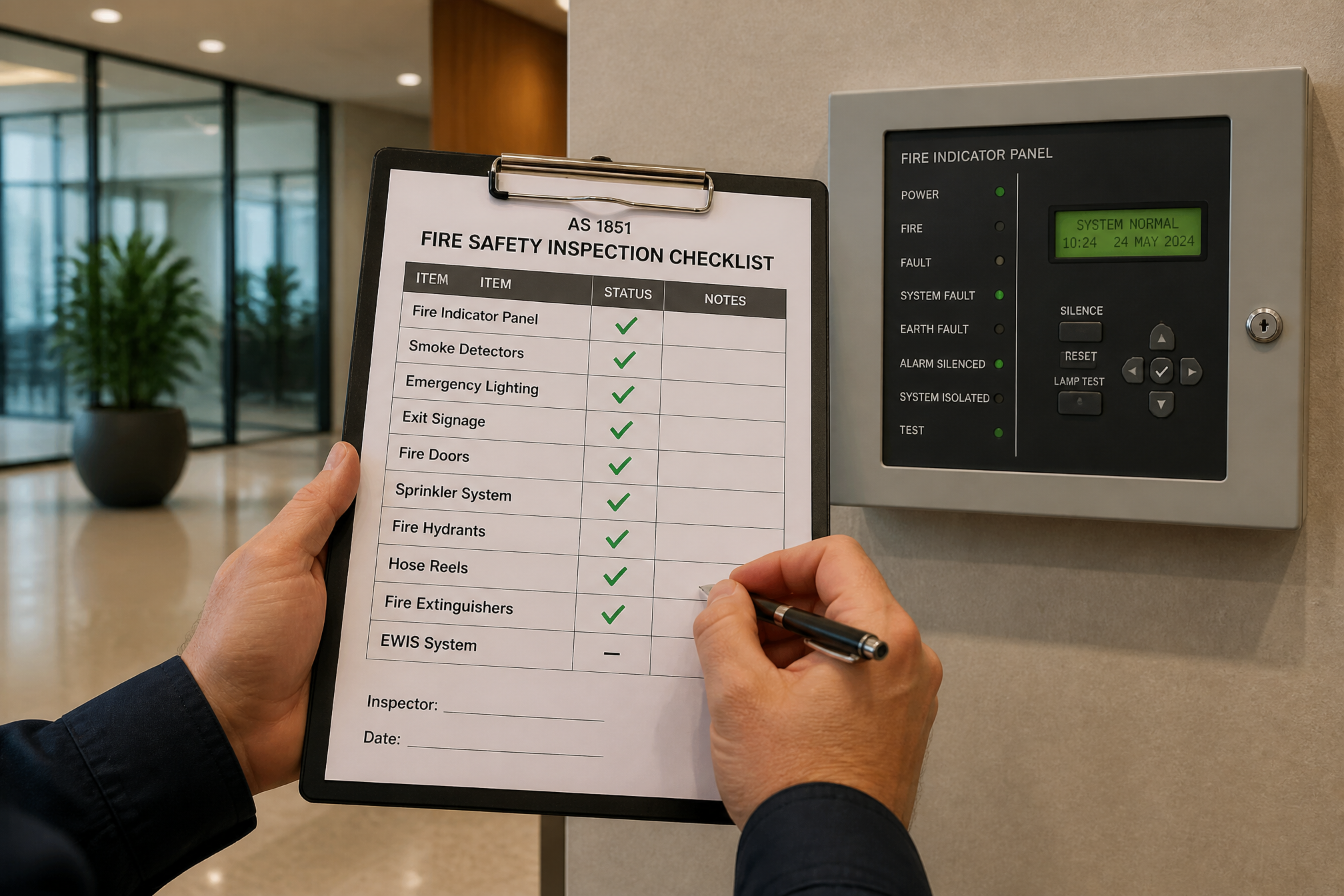
If you manage or own a commercial building in Western Sydney — whether it's a strata block in Parramatta, a warehouse in Blacktown, or a mixed-use development in Liverpool — the words "Annual Fire Safety Statement" probably appear on your calendar once a year. But here's what surprises many building owners and owners corporations I've worked with: the AFSS inspection is far more rigorous than a quick walk-around with a clipboard. This commercial building fire safety inspection checklist breaks down exactly what an Accredited Practitioner (Fire Safety), or APFS, looks for on the day, why certain items cause certification to stall, and what you can do right now to make sure your building isn't caught off-guard when the assessor arrives.
What Is an AFSS and Why Does It Matter for Your Building?
The AFSS is a legal document that confirms your building's fire safety systems — like alarms, exit lights, sprinklers, and hydrants — have been inspected by a qualified expert and are functioning as required. It is mandated under Part 12, Division 2 (sections 88–91) of the Environmental Planning and Assessment (Development Certification and Fire Safety) Regulation 2021 (NSW). In plain English: if your building has a fire safety schedule, you must lodge this document every year — no exceptions.
Class 2 to Class 9 buildings — including commercial offices, retail premises, warehouses, strata residential buildings, and mixed-use developments — must submit an AFSS to their local council every 12 months. From my experience working across Greater Western Sydney, many building owners in Cumberland and Canterbury-Bankstown are surprised to discover their older mixed-use buildings fall squarely into Class 7 or Class 9 territory, making AFSS a non-negotiable annual obligation rather than something discretionary.
Once completed, the AFSS must be submitted annually to your local council and Fire and Rescue NSW, with a copy displayed in a prominent location in your building. In NSW, it is an offence under the Environmental Planning and Assessment Act 1979 not to submit a compliant AFSS to council by the due date. Offences can be subject to a court-imposed penalty of up to $110,000 or an on-the-spot fine for failing to provide an annual fire safety statement. That is not a risk any property manager should be prepared to accept.
Who Can Legally Conduct Your AFSS Assessment?
This is an area where I've seen costly mistakes made — particularly in older strata buildings across Fairfield and Penrith where the same tradesperson has been "doing the fire check" for years without formal accreditation. The rules have tightened considerably, and getting this wrong can invalidate your entire statement.
A fire safety statement is a document issued by or on behalf of the owner of an existing building. The statement confirms that an Accredited Practitioner (Fire Safety) has assessed, inspected, and verified the performance of each fire safety measure that applies to the building. The key phrase here is "Accredited Practitioner (Fire Safety)" — known in the industry as an APFS. This accreditation is administered through the Fire Protection Association Australia (FPA Australia) under its Fire Protection Accreditation Scheme (FPAS).
The NSW Government requires that only persons accredited as competent fire safety practitioners under the FPA Australia Fire Protection Accreditation Scheme are licensed to undertake annual assessments. The accreditation is broken into several specialty fields: Fire Detection, HVAC, Sprinklers, and Passive. This means a single practitioner may not be qualified to assess every measure in your building. In practice, your provider may have multiple APFS practitioners, each accredited for specific measures — for example, detection and alarms versus sprinklers versus passive fire measures. Don't assume any technician can sign — check accreditation and scope against your Fire Safety Schedule. In my professional opinion, verifying your assessor's FPAS accreditation scope before they walk through your door is one of the single most important pre-inspection steps a building manager can take.
The AS 1851-2012 Mandate: A Major Shift in 2026 That Changes Everything
If you haven't heard about the AS 1851-2012 mandatory compliance change that took effect on 13 February 2026, you need to stop and read this section carefully. This is the most significant shift in NSW fire safety compliance in years, and it directly affects how every AFSS inspection is now conducted.
From 13 February 2026, all Class 1b and Class 2 to Class 9 buildings in NSW must have essential fire safety measures inspected and tested in accordance with AS 1851-2012. A pivotal outcome of the 2022 NSW fire safety reforms is the transition of AS 1851-2012 from a widely accepted best-practice guideline to a mandatory legal requirement. Effective 13 February 2026 (deferred by 12 months from the original February 2025 deadline), buildings required to provide annual or supplementary fire safety statements are legally obligated to maintain all installed essential fire safety measures in accordance with AS 1851-2012.
Building owners must now maintain all installed essential fire safety measures in line with AS 1851-2012, have a documented preventative maintenance program in place, and schedule routine servicing — monthly, quarterly, six-monthly, annual, five-yearly — exactly as the standard specifies, while keeping full inspection, testing, and maintenance records. What this means practically is that your assessor will now arrive expecting to see a documented maintenance trail, not just functioning equipment on the day. A major change took effect on 13 February 2026, requiring building owners to maintain essential fire safety measures covered by AS 1851-2012 in line with that standard. If your inspection checklist has not been updated to reflect that shift, you are relying on an outdated system. I have seen buildings in Blacktown that had perfectly maintained physical systems fail to obtain their AFSS endorsement simply because their maintenance records were incomplete or not in the format the standard requires.
The Core Commercial Building Fire Safety Inspection Checklist: What Assessors Examine
From my professional experience conducting and preparing for AFSS assessments across Western Sydney's commercial and strata landscape, the inspection consistently falls into two categories: active fire safety measures and passive fire safety measures. Both must be assessed and both must be performing to the standard specified in your building's fire safety schedule.
A fire safety audit is a comprehensive evaluation of a building's fire protection systems. It includes the inspection and testing of active systems (like fire alarms and sprinklers) and passive features (like fire-rated walls and doors). Audits also assess documentation, evacuation plans, and training procedures to ensure readiness.
Here is what a compliant AFSS assessor will examine systematically during a typical commercial building visit:
Fire detection and alarm systems: Smoke detectors, heat detectors, manual call points, and the fire indicator panel (FIP) are tested for correct operation, zoning accuracy, and integration with the building's emergency warning system.
Automatic sprinkler systems: Flow tests, pressure readings, sprinkler head condition, and control valve positions are all scrutinised under AS 1851-2012 requirements.
Fire hydrants and hose reels: Tested for water pressure and flow, accessibility, and condition of hose, nozzle, and fittings — blocked hydrants are among the most commonly cited defects.
Portable fire extinguishers: Pressure indicators, service tags, accessibility, and correct placement relative to fire risk zones.
Emergency and exit lighting: Emergency and exit lighting are maintained in accordance with standards referenced in the building's Fire Safety Schedule, commonly AS/NZS 2293. Assessors check illumination levels, battery backup duration, and signage legibility.
Fire doors: Self-closing mechanisms, latching hardware, intumescent seals, and door leaf integrity are all checked. Damaged or wedged-open fire doors are a frequent cause of certification failure.
Paths of travel and egress: Egress and exit systems — including stairs, paths of travel, and exit doors — are verified as functioning correctly. Obstructed corridors and locked or obscured exit doors are fail points I encounter regularly, particularly in busy retail and industrial precincts.
Passive fire measures: Fire-rated wall penetrations, cavity barriers, fire dampers, and smoke seals are inspected to confirm the building's passive fire compartmentalisation remains intact.
Emergency warning and intercommunication systems (EWIS): Where installed, these are tested for audibility, zoning, and correct operation in accordance with the building's fire safety schedule.
Mechanical smoke control systems: Particularly relevant in multi-storey and underground car park developments common throughout Parramatta CBD and Penrith's growth corridors.
Maintenance records and documentation: Auditors seek evidence, not promises. Your service logs, defect reports, and rectification records will be reviewed.
Active vs Passive Fire Safety Measures: A Compliance Comparison
One of the most common misconceptions I encounter among strata committees and facility managers — especially those new to managing a commercial building — is treating active and passive fire measures as if they carry different compliance weight. They don't. Both are listed on your fire safety schedule, both must meet their specified minimum standard of performance, and an assessor cannot endorse the AFSS unless every listed measure passes. The table below summarises the two categories, the governing standards an assessor will reference, and the typical inspection frequency mandated under AS 1851-2012:
| Measure Type | Examples | Governing Standard(s) | Typical Inspection Frequency | Common Defects Found |
|---|---|---|---|---|
| Active — Detection & Alarm | Smoke detectors, heat detectors, manual call points, fire indicator panel | AS 1851-2012; AS 1670 | Monthly visual check; annual full test | Faulty detector heads, outdated FIP firmware, gaps in zone coverage |
| Active — Suppression | Automatic sprinklers, fire hydrants, hose reels | AS 1851-2012; AS 2118 | Six-monthly pressure test; annual flow test | Blocked heads, insufficient water pressure, corroded pipework |
| Active — Portable Suppression | Fire extinguishers, fire blankets | AS 1851-2012; AS/NZS 1841 | Six-monthly service; annual full inspection | Expired service tags, discharged or low-pressure units, wrong type for risk |
| Active — Emergency Egress | Emergency lighting, exit signs | AS/NZS 2293 | Monthly functional test; annual full discharge test | Failed battery backup, blown lamps, illegible or missing signage |
| Active — Warning Systems | EWIS, occupant warning systems | AS 1851-2012; AS 7240 | Six-monthly; annual full system test | Inaudible or incorrect zone announcements, faulty microphones |
| Passive — Compartmentalisation | Fire doors, fire-rated walls, floor penetrations, cavity barriers | AS 1851-2012; BCA/NCC | Annual inspection | Wedged-open doors, failed self-closers, unsealed penetrations |
| Passive — Smoke Control | Fire dampers, smoke seals, mechanical smoke control systems | AS 1851-2012; AS 1668 | Annual actuation test; five-yearly full inspection | Corroded or seized dampers, missing inspection access panels |
The Defect-Rectification Process: What Happens When Something Fails
Here is the reality I wish more building owners understood before their assessment day: failing an inspection item does not automatically mean you miss your AFSS deadline — but it does trigger an urgent rectification obligation. The APFS will carry out a comprehensive on-site inspection to verify all fire systems have been maintained and tested according to AS 1851. The APFS then provides a detailed report highlighting any defects that must be addressed before the AFSS can be signed. Once all issues are resolved, the APFS endorses the AFSS.
Any defects identified during inspection must be repaired before the statement can be signed. The final AFSS is lodged with the council and Fire and Rescue NSW. If even one item does not meet the required standard, the AFSS cannot be issued until the issue is resolved. From my experience, the buildings that handle this process best are those that schedule their assessment well ahead of their due date. Schedule inspections a month or two before the deadline. That leaves time to address requirements such as a broken fire door or a leak in a sprinkler line. Nobody wants a scramble at the last minute. Early planning cuts stress and prevents extra charges for re-inspections.
Common defects include expired extinguishers, inoperative alarms, blocked hydrants, damaged fire doors, failed emergency lighting, missing identification tags, and poor egress signage. In Western Sydney's older building stock — particularly industrial premises in Wetherill Park and Smithfield, and ageing strata buildings across Merrylands and Auburn — I find that passive fire measures, especially unsealed penetrations caused by telecommunications and data cable upgrades, are among the most frequently overlooked defects. Tenants drill through fire-rated walls to run cables and simply don't notify the building manager. By the time the assessor arrives, the compartmentalisation that took years to certify has been compromised by a cordless drill and a 20-metre data cable.
In NSW, you have a 3 month period between the accredited practitioner conducting their assessment and submitting the endorsed AFSS to the local council. Use that window wisely — don't wait until the final week to address defects identified in the assessor's report.
Documentation and Recordkeeping: The Evidence Trail That Supports Certification
Increasingly, the quality and completeness of your maintenance records is as important to the AFSS process as the condition of the physical systems themselves. This is one of the most overlooked elements I encounter when helping buildings in Canterbury-Bankstown and Fairfield prepare for their assessments.
AS 1851-2012 specifies inspection frequencies, testing methods, documentation requirements, and record retention obligations. The building owner is legally responsible for ensuring compliance. While servicing may be carried out by accredited contractors, legal responsibility for compliance remains with the building owner. That is a critical distinction — you cannot simply outsource responsibility to your fire services contractor and assume the obligation transfers with it.
In practical terms, your AFSS documentation package should include:
A current copy of your building's Fire Safety Schedule, listing every essential fire safety measure and its minimum standard of performance
Service logbooks or electronic maintenance records for every listed measure, showing inspection dates, technician details, and results
Defect reports from previous service intervals and corresponding rectification records confirming close-out
Evidence of the APFS practitioner's accreditation and scope, matched against the measures they are endorsing
Previous AFSS submissions, to confirm the 12-month lodgement cycle is being maintained
Records of any building modifications, renovations, or fit-outs that may have affected fire safety measures since the last assessment
Creating a single folder with your asset register, test sheets, defect close-outs, training records, and previous audit reports — with key contacts and escalation steps — means that if an assessor asks, you can provide evidence in minutes. That level of preparation is not bureaucratic over-engineering — from my professional opinion, it is the difference between a smooth certification and an expensive delay.
Frequently Asked Questions
Does every commercial building in Western Sydney need an AFSS?
If you own or manage a Class 2 to Class 9 building in New South Wales, submitting an Annual Fire Safety Statement is not optional — it is a legal requirement. This covers the vast majority of commercial, retail, industrial, strata residential, and mixed-use buildings throughout Western Sydney LGAs including Parramatta, Blacktown, Penrith, Liverpool, Cumberland, Canterbury-Bankstown, and Fairfield. Standalone houses (Class 1a) and basic sheds or garages (Class 10) are generally exempt, but if you are in any doubt about your building's classification, you should obtain professional advice specific to your property and consult your local council.
Who actually signs the AFSS — the building owner or the assessor?
The Fire Safety Certificate and Annual Fire Safety Statement can only be signed by the owner or their agent, not by the Accredited Practitioner Fire Safety person. The owner issues the AFSS, not the practitioner who performed the inspection. The APFS endorses the statement — that is, they verify that the measures meet the required standard — but the formal legal declaration is made by the building owner or their authorised representative. Building owners and strata committees should understand this distinction clearly, as it means the legal obligation and liability rest with the owner.
What happens if defects are found on inspection day?
Finding defects is not unusual — it is a normal part of the AFSS process, particularly for older buildings or those that have undergone recent tenancy fit-outs. The APFS provides a detailed report highlighting any defects that must be addressed before the AFSS can be signed. Once all issues are resolved, the APFS endorses the AFSS. The critical factor is time: the further ahead of your due date you schedule the assessment, the more room you have to complete rectifications, organise trades, obtain parts, and arrange a re-inspection without risking a late or non-compliant submission. Buildings that leave the inspection to the final weeks of their compliance window regularly find themselves facing penalty exposure through no fault other than poor scheduling.
What changed with AS 1851-2012 becoming mandatory in NSW?
A pivotal outcome of the 2022 NSW fire safety reforms is the transition of AS 1851-2012 from a widely accepted best-practice guideline to a mandatory legal requirement. From 13 February 2026, buildings required to provide annual or supplementary fire safety statements are legally obligated to maintain all installed essential fire safety measures in accordance with AS 1851-2012. Previously, many fire protection companies used AS 1851 as a guideline rather than a strict requirement, leading to varied maintenance practices. The practical impact is that your building's routine servicing intervals, testing methods, and documentation must now align precisely with the standard — not just with whatever approach your previous contractor happened to follow. If your current maintenance program was set up before February 2026, it is worth having it reviewed against the current mandatory requirements to confirm it is fully compliant.
Disclaimer: This article is intended for general informational purposes only. It does not constitute legal advice. Building owners, strata committees, and owners corporations should seek independent professional advice regarding their specific fire safety compliance obligations and the particular requirements of their building under NSW legislation.
Book Your Annual Fire Safety Statement Inspection with Fire Safe Today
Understanding what your AFSS assessor is looking for is the first step — but having a qualified, experienced team standing beside you on inspection day is what actually gets your statement signed and lodged on time. Fire Safe is Western Sydney's specialist Annual Fire Safety Statement provider, serving building owners, strata committees, owners corporations, and facility managers across Parramatta, Blacktown, Penrith, Liverpool, Canterbury-Bankstown, Cumberland, and Fairfield every day. Our accredited practitioners conduct thorough AS 1851-2012 compliant inspections, identify and document defects early, and work with you to clear rectifications before your deadline — so there are no surprises, no last-minute scrambles, and no penalty notices from council. Whether you need a full Annual Fire Safety Statement inspection, an AS 1851 routine servicing program, or a compliance review to align your building with the February 2026 mandatory changes, Fire Safe has the local knowledge and accreditation to deliver. Call us on 1300 347 372 or use the contact form on this page to book your AFSS inspection today.