Can Another Fire Company Take Over and Sign Off Work Someone Else Started?
Can Another Fire Company Take Over and Sign Off Work Someone Else Started?
Short answer: yes. It happens more often than people think, and it is usually straightforward.
The reason people ask is almost always one of three things. Your current provider has gone quiet and your statement is due. Their price went up and you want to move. Or the one we see most: the person doing your inspections is not accredited to sign the Annual Fire Safety Statement at the end of them.
That third one catches a lot of building owners out, so start there.
The most common version: your inspector cannot sign
Inspecting a building and certifying it are two different jobs with two different requirements.
Anyone with the right trade skills can test a hydrant or check an exit light. But the Annual Fire Safety Statement has to be assessed and signed by an accredited practitioner against every essential fire safety measure on your Fire Safety Schedule. If the person on site cannot sign it, the inspections are not worthless, but they do not finish the job either.
We got a call from a building in Lidcombe where exactly that had happened. Their provider had been doing the inspections for them and had been for a while. When it came time to issue the statement, the provider was not FSA accredited to sign it. The work had been done. The paperwork could not be completed. They had to bring us in to inspect and sign the AFSS properly.
They paid for the work twice.
Before you engage anyone, ask for their accreditation number and check it on the FPAS register. It takes two minutes. It is a lot cheaper than finding out in month eleven.
What a new provider needs from you
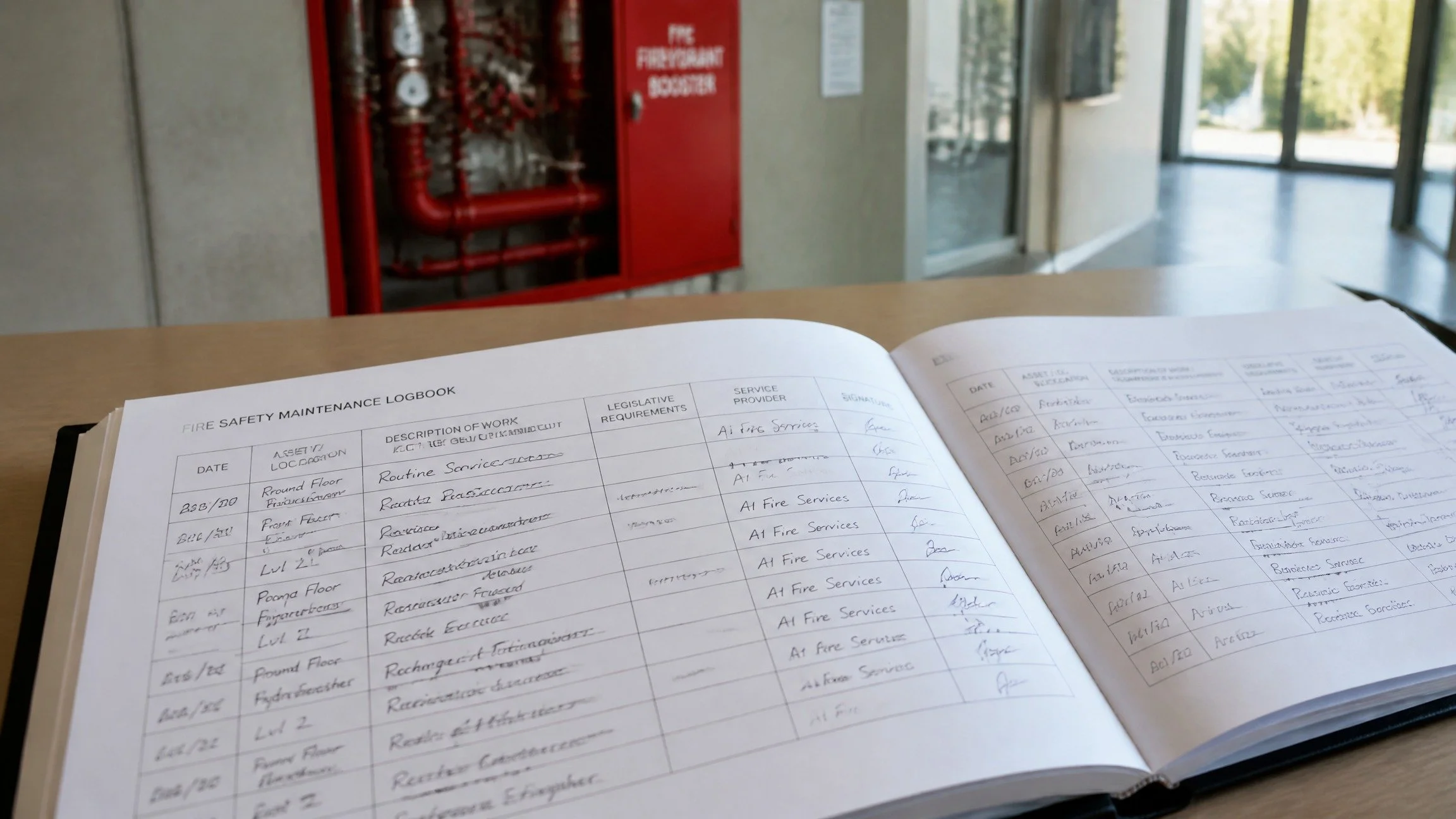
Changing providers is a handover, not a fresh start. The NSW Government is explicit about this. Its guidance on building owner responsibilities under AS 1851-2012 says that when changing contractors during a building's lifetime, owners should provide the existing logbook to the new contractor.
That is the key document. Get four things together:
Your current Fire Safety Schedule. This lists every measure that has to be inspected. It sets the scope and the price.
The hard copy logbook. From 13 February 2026, a physical logbook has to be kept on site. It is your service history, and it is what tells the new provider what has been done and when.
Your last Annual Fire Safety Statement. This sets your due date. The date runs from the last statement, not the financial year.
Any outstanding defect reports. So the new provider knows what is already open.
If your old provider is holding the logbook and will not release it, that is worth knowing early. Records have to be kept for at least 7 years and made available for inspection. Ask for it in writing.
What carries over, and what has to be re-done
This is the part people worry about, and the honest answer is: it depends on the records.
Where there is a complete logbook with dates, results and the servicing technician recorded, a new provider can generally pick up the service history from there and carry on with the cycle.
Where records are missing, incomplete, or the service intervals have been skipped, some measures will need re-testing before anyone can certify them. Nobody accredited is going to sign a statement for equipment they cannot evidence was tested.
The practical rule: good records mean a clean handover. Bad records mean some re-testing. The worse your previous provider's paperwork, the more the change costs you, which is its own argument for checking accreditation up front.
We can accept repairs completed by qualifed and compeitent person/s for: Fire Hydrants, Fire Sprinkler Systems, Fire Alarm Panels, Exit Signage and Emergency Lighting, Fire Extinguishers, Fire Hose Reels, Smoke Alarms and other essential fire safety measures
What it costs to switch
Less than most people expect, and almost always less than paying twice.
We price against the measures actually on your Fire Safety Schedule, not a flat rate. AFSS pricing starts from $375 + GST for a small commercial premises, $495 + GST for a warehouse or industrial unit, and $725 + GST for a multi-storey or strata building.
If re-testing is needed because of gaps in the previous records, we tell you before you commit, not after we arrive.
You do not have to wait for your renewal date
A common misunderstanding is that you are locked in until your statement expires. You are not. The building owner engages whoever they want. There is no transfer process to go through and no permission to seek.
The one thing worth getting right is timing. Changing in the last two weeks before your due date is possible but tight, especially if defects turn up. Two months out is comfortable.
Three questions before you engage anyone
Ask these of whoever you are considering, including us.
What is your accreditation number, and what class are you accredited for? If you get a vague answer, stop there.
Is re-inspection included if defects need re-checking? A low headline price with a separate charge every time somebody comes back is not a low price.
Will you lodge with council and Fire and Rescue NSW, or is that on me? Both lodgements are required. Know who is doing them.
If you are in this situation now
Send us your Fire Safety Schedule and your last statement. We will tell you what carries over from your existing records, what needs re-testing, and what it costs, within one business day. If it turns out your current provider can finish the job, we will tell you that too.
Call 1300 347 372 or get a firm quote.
David Sayes is an FPAS and FSA-accredited Fire Safety Assessor, Accreditation No. F022816A, with a Diploma of Fire Systems Design and C2FPIT certification. FireSafe AU has been servicing Western Sydney buildings for 16 years.
Disclaimer: This article is intended for general informational purposes only. It does not constitute legal advice. Building owners, strata committees, and property managers should seek independent professional advice regarding their specific compliance obligations under the Environmental Planning and Assessment Regulation 2021, AS 1851-2012, the National Construction Code, and any applicable Australian Standards. Requirements will vary depending on building class, the specifics of the Fire Safety Schedule, and the age and condition of installed passive fire measures.