What Happens If You Miss Your AFSS Deadline? NSW Penalties, Fines & Real Consequences Explained
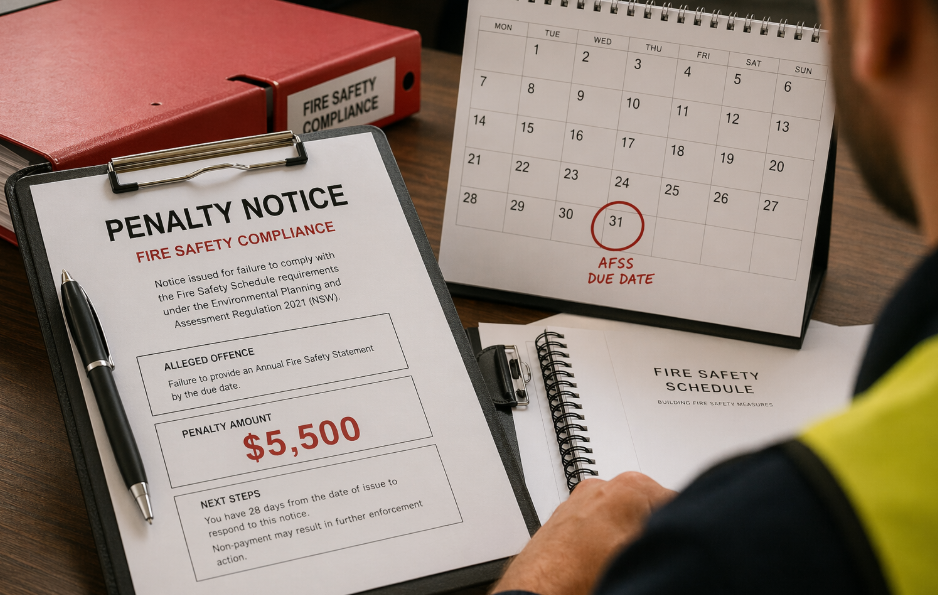
Your AFSS is overdue. What happens next?
If your Annual Fire Safety Statement (AFSS) is late, missing, or wasn't lodged at all this year, you are already accumulating risk. Every day.
NSW fire safety law has sharp teeth — and since the 13 February 2026 reforms that made AS 1851-2012 mandatory across the state, councils have tightened their enforcement posture significantly. Fines are being issued faster, audits are more thorough, and property owners are discovering that what used to be a paperwork oversight is now a direct hit to the hip pocket.
This article breaks down exactly what a missed or defective AFSS can cost you in NSW — the penalties, the council action, the insurance implications, and the personal liability. It also tells you what to do if you're already overdue.
Short version: you can fix this. But every week you wait, it gets more expensive.
First — what is an AFSS, and when is it due?
An Annual Fire Safety Statement is a document the owner of a building must lodge with the local council and Fire & Rescue NSW once every 12 months. It certifies that every essential fire safety measure listed on the building's Fire Safety Schedule has been inspected by a competent fire safety practitioner and is capable of performing to the standard it was designed to meet.
Your AFSS due date is based on the anniversary of your original Fire Safety Certificate (the certificate issued when the building was first occupied) or the date of your last AFSS. It does not move. It does not get extended because you were busy.
If your building was built pre-1988, it may also require a Supplementary Fire Safety Statement. The same rules apply.
The rule is simple: one statement, every year, on time, signed by a qualified practitioner. Miss any part of that and the consequences start stacking up.
The immediate financial penalty
In NSW, councils have the power to issue penalty infringement notices (PINs) to building owners who fail to lodge an AFSS on time.
The base penalty is significant in its own right — but the real pain comes from the escalation.
The typical penalty structure looks like this:
Week 1 overdue: You receive a reminder letter and often a base-level penalty notice.
Weeks 2–4 overdue: Penalty notices increase in frequency. Some councils issue weekly fines.
Beyond week 4: Fines can reach $3,000 to $4,000 per week of ongoing non-compliance in some council areas.
To put that in numbers: a building owner who ignores their AFSS for a full quarter can easily accumulate $30,000 or more in fines before any other consequence kicks in.
These are not theoretical numbers. Western Sydney councils — Parramatta, Blacktown, Penrith, Liverpool, Canterbury-Bankstown, Cumberland and Fairfield — have all been issuing escalating penalty notices to non-compliant owners.
Council enforcement doesn't stop at fines
If the building continues to be non-compliant, councils have significantly more serious tools at their disposal.
Fire Safety Orders. A council can issue a formal order under the Environmental Planning and Assessment Act 1979 requiring the owner to carry out specified fire safety works or rectifications within a set timeframe. Failing to comply with an order is a separate offence that carries its own penalties — and in some cases exposes the owner to prosecution in the Land and Environment Court.
Fire Safety Investigations. Fire & Rescue NSW has its own inspectorate. If a fire officer attends your building for any reason and notices compliance issues, that can trigger a full formal investigation — including site inspections, document subpoenas, and referrals to council.
Prohibition on occupation. In serious cases, where essential fire safety measures are not operational or the building is deemed an unacceptable fire risk, authorities can issue orders preventing continued occupation until the issues are rectified. For a commercial building, that means lost tenants, lost rent, and angry occupiers.
Property caveats. Prolonged non-compliance can be registered on the title of the property, which makes future sale or refinancing difficult.
Your insurance is on the line
This is the consequence most building owners don't see coming — and it's often the most expensive.
Building insurance policies almost universally require the owner to comply with all relevant laws, regulations and maintenance standards. Since 13 February 2026, AS 1851-2012 is that standard across NSW.
Here's what that means in practice:
Claim denial. If a fire occurs and the investigation reveals that your AFSS was overdue or your fire safety measures weren't maintained to AS 1851-2012, the insurer has grounds to deny the claim — in full. On a large commercial or strata building, that's a loss in the millions of dollars.
Policy cancellation. Insurers review compliance status at renewal. An overdue AFSS can trigger non-renewal.
Premium loading. Even if the insurer keeps you on, expect significantly higher premiums at next renewal once non-compliance is on record.
Public liability exposure. If an occupier, tenant or visitor is injured in a fire-related incident, you can face civil claims that insurance won't respond to if you weren't compliant at the time of the incident.
Fire is a statistically rare event — but when it happens, the cost of being uninsured (or under-insured) dwarfs any saving from skipping fire safety servicing.
Strata committees and owners corporations — personal exposure
If the non-compliant building is a strata property, the responsibility sits with the owners corporation. And that flows through to the people making (or failing to make) the decisions.
Executive committee members can personally face:
Disputes with lot owners who take action through NCAT (NSW Civil and Administrative Tribunal) over failure to discharge compliance obligations.
Claims for recoverable losses where the owners corporation is found to have acted negligently.
Reputational damage as strata managers, lot owners and prospective buyers review the committee's compliance history.
Strata managers who fail to escalate AFSS compliance clearly to their owners corporation may also face professional complaints and exposure under their professional indemnity obligations.
If you sit on a strata committee in Western Sydney and your building's AFSS is overdue, this is not a "we'll get to it" item. It should be the top item on your next meeting agenda.
The sale-killer nobody talks about
Here's a less obvious consequence that catches owners out during exit:
You cannot cleanly sell a commercial or strata property in NSW without a current, compliant AFSS.
Conveyancers representing sophisticated buyers will flag an overdue or defective AFSS immediately during due diligence. In practice:
Sale delays. Buyers will either walk away or demand the seller rectify compliance before settlement — at the seller's cost, on the seller's timeline.
Price reductions. A known compliance gap is bargaining leverage. Expect the buyer to push for a reduction of tens of thousands of dollars or more to offset their rectification risk.
Deal collapses. In hot markets, buyers simply move on rather than inherit the problem. You lose the transaction.
If there's any chance of a sale or refinance in the next 12–24 months, your AFSS needs to be current and fully backed by compliant AS 1851-2012 records. Full stop.
"My building is old — can I get an extension?"
The short answer is no. The AFSS regime does not provide for extensions on the basis of building age, ownership transfer, or contractor availability.
If your fire protection provider has let you down — for example, by not scheduling a service in time or by failing to produce records that meet AS 1851-2012 — that's a conversation for your provider. It doesn't stop the clock with the council.
The one practical concession for older buildings under the new AS 1851-2012 regime is this: long-duration services (5-yearly, 10-yearly and 25-yearly) are counted from 13 February 2026 onward. An older building does not need to retrospectively complete all of those services before its first compliant AFSS. But the annual service and the baseline documentation does need to be current.
You've missed your deadline. What now?
Don't panic. And don't hide from it — inaction is the only path that guarantees escalation.
Here's the clean 5-step recovery:
Check how overdue you actually are. Find your last AFSS or your Fire Safety Certificate. Compare to today's date.
Engage an accredited fire protection service provider immediately. You need someone qualified to carry out the full set of inspections under AS 1851-2012 and sign off the statement. Don't try to "catch up" with your previous provider if they're the reason you're late.
Get a written scope and schedule. A proper provider will visit your building, review the Fire Safety Schedule, inspect every essential measure listed, and give you a written report covering any defects or non-conformances.
Rectify critical defects quickly. Non-conformances need to be recorded and addressed before the AFSS can be signed off. A good provider will help you prioritise these by risk and cost.
Lodge the AFSS with council and Fire & Rescue NSW. Once the practitioner has signed off, the statement goes in. The clock stops accumulating penalties at that point.
Depending on your building size and the complexity of your fire safety measures, this can often be done within 2–3 weeks from the day you pick up the phone.
Why Fire Safe can get you compliant — fast
Fire Safe is a Western Sydney based fire safety specialist. We work with commercial building owners, strata committees and property managers across Parramatta, Blacktown, Penrith, Liverpool, Canterbury-Bankstown, Cumberland and Fairfield.
What we do for late or non-compliant buildings:
Rapid site assessment. We turn up, inspect the building, and give you a straight-up picture of where you stand.
Full AS 1851-2012 servicing. Every essential measure covered by the standard, documented in a proper logbook left on site.
AFSS inspection and lodgement. Accredited practitioner sign-off where required.
Defect rectification. Clear priorities, clear costs, no surprise line items.
Ongoing compliance tracking. We remind you 60 days before your next AFSS is due, so this never happens again.
We don't sell fear. But we also don't sugar-coat it — if your AFSS is overdue, that's a problem worth fixing this week.
Act now — don't wait for the next fine to arrive
Every week an overdue AFSS sits on your building is a week of accumulating penalties, mounting insurance risk, and growing legal exposure.
Call Fire Safe on 1300 347 372 for a same-day response on overdue AFSS buildings. We'll book an inspection, quote the work, and get your statement lodged as fast as the regulations allow.
Or send us the details through the contact form on this page and we'll come back to you within one business day with a clear plan to get you compliant.
Your building. Your compliance. Your exposure. Let's close the gap.
This article is general information and not legal advice. For advice specific to your building or circumstances, contact Fire Safe on 1300 347 372 or consult a qualified fire safety practitioner and your solicitor.