Most building owners know about the Annual Fire Safety Statement. Far fewer know that some buildings need a second type of statement as well, sometimes several times a year.
If your Fire Safety Schedule lists a critical fire safety measure, you need supplementary statements. Miss them and you are non-compliant for most of the year, even with a valid AFSS sitting on the wall.
Here is how it works.
What a supplementary fire safety statement actually is
A supplementary fire safety statement is a statement issued by or on behalf of the building owner, declaring that each critical fire safety measure listed in it has been assessed by an accredited practitioner (fire safety) as capable of performing to at least the standard required by the current Fire Safety Schedule.
Same basic shape as the annual statement. Different scope, different timing.
Two things make it different from the AFSS:
It only covers critical measures, not every essential measure in the building.
It does not include the exit systems declaration. On an annual statement the owner also declares that an accredited practitioner has inspected the building's fire exit systems. That part is not in a supplementary statement.
A critical fire safety measure is also an essential fire safety measure. It is a subset, not a separate category.
The trigger is your Fire Safety Schedule, not the building type
This is the part people get wrong.
There is no list of building types that need supplementary statements. There is no rule that says "childcare centres need them" or "anything over three storeys needs them."
Critical fire safety measures are measures that require periodic assessment and inspection at intervals of less than 12 months. They are specifically identified on the Fire Safety Schedule for your building.
So the question is never "does a building like mine need one." The question is "what does my schedule say."
How to tell if your building needs one
Get your current Fire Safety Schedule out and read it.
The schedule lists every essential fire safety measure for the building and the standard each one has to perform to. Where a measure is critical, the schedule identifies it and states the interval at which it must be assessed.
If nothing on your schedule is marked as requiring assessment more often than annually, you do not need supplementary statements. If something is, you do, at the interval the schedule specifies.
The intervals come from the schedule for your building. They are not a standard set of dates that apply to everyone, which is why two buildings on the same street can have completely different obligations.
If you cannot find your Fire Safety Schedule, or you are not sure it is current, that is its own problem and worth sorting before anything else. We cover that in what is a Fire Safety Schedule in NSW.
Who assesses it and who signs it
Same split as the annual statement, and the same trap.
The assessment must be done by an accredited practitioner (fire safety) who holds relevant accreditation to assess that specific measure.
The declaration is signed by the owner, or by an agent with proper written authority from the owners. On the approved form, the annual declaration is section 8. The supplementary declaration is section 9.
And the restriction that catches people out:
An accredited fire safety practitioner must not make the declaration where they have assessed a fire safety measure.
That extends further than most people realise. The declarant must not be a practitioner involved in assessing any of the measures, and that includes an employer, an employee, or a direct associate of the accredited practitioner.
In plain terms: if we assess your critical measures, nobody at FireSafe signs your declaration. You do, or your authorised agent does. Any provider offering to handle both ends of that is offering you a defective statement.
One form, two declarations
The approved Fire Safety Statement template published by the Planning Secretary covers both. Version 4 has been required since 1 September 2022. The annual declaration is section 8, the supplementary is section 9.
You cannot alter the form. That includes adding or altering letterheads and logos, or adding and removing sections. A provider handing you a nicely branded "our own template" may be handing you something that contravenes the Regulation.
Where it has to go
Fire and Rescue NSW. The owner must give FRNSW a copy of the supplementary statement, along with the current Fire Safety Schedule, as soon as practicable after its issue (section 91). There is no charge for this.
Your council. Here I will be straight with you about what the public guidance does and does not say. The FRNSW page covers the supplementary copy going to FRNSW and does not mention council. Other NSW guidance refers to owners submitting annual or more frequent statements to both council and Fire and Rescue NSW.
Councils differ on what they want and how they want it. Check your council's fire safety page, or ring them, rather than assuming either way. Sending a copy you did not strictly have to send costs you nothing. Not sending one you did is the expensive option.
Keep the FRNSW confirmation either way.
You have to display it as well
Yes, supplementary statements too.
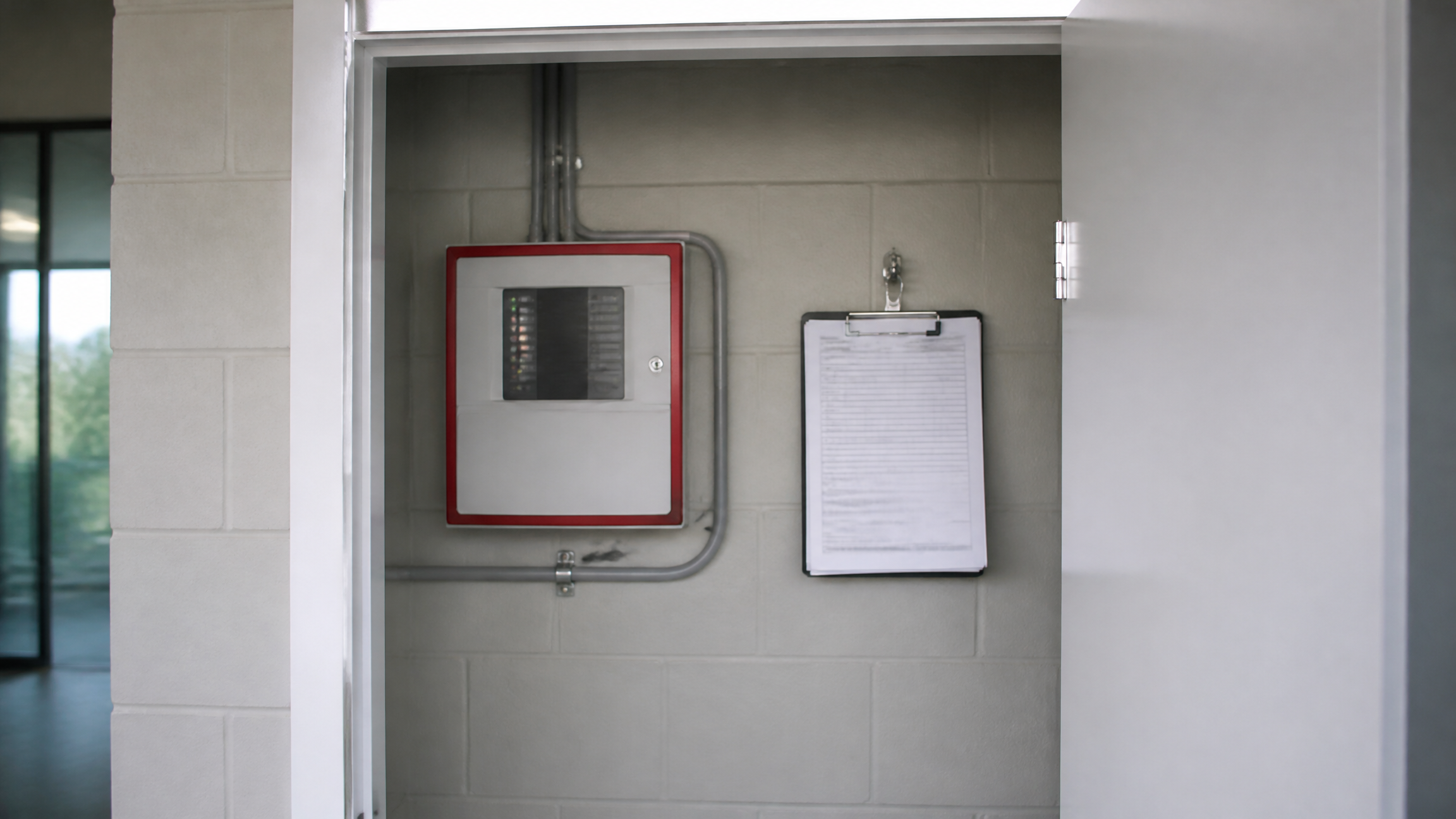
The owner must ensure a copy of the annual or supplementary fire safety statement, together with the current Fire Safety Schedule, is prominently displayed in the building.
This is the single easiest thing to get caught on, because an inspector can check it without asking you for a thing. They just look at the wall.
We wrote about a childcare centre in Smithfield that got fined over exactly this. The building was fine. The statement was valid and lodged. It just was not on the wall. Full story in how to lodge your AFSS in NSW.
If your schedule requires supplementary statements, the displayed copy needs to stay current through the year, not just after the annual.
What we see go wrong
A site in Lidcombe had a mechanical air handling system signed off as compliant with AS 1668.1. The paperwork was in order. The system had never been connected.
You cannot certify a measure that does not work, and you cannot sign a statement saying it does. So we went to council early, rather than letting the due date arrive with nothing to hand them.
What came out of that was a supplementary fire safety statement covering the measures we could certify, and a three month extension on the mechanical measure while the repairs were done. Once the system was connected and working, we issued the full Annual Fire Safety Statement.
Two things worth taking from it.
A sign-off is not proof. Somebody certified that system. It had never been connected. If you have inherited a building, or inherited a provider, do not assume the existing paperwork reflects what is actually installed and working.
And council is far more reasonable before your due date than after it. An owner who comes to them with a defect, a plan and a timeframe gets a conversation. An owner who goes quiet and misses the date gets a notice.
What this costs
Supplementary assessments are additional to the annual inspection, because they are additional visits.
What they cost depends entirely on how many critical measures your schedule lists and how often it requires them assessed. A building with one critical measure assessed six-monthly is a very different job to one with several measures on different cycles.
We quote these against your actual schedule rather than a flat rate, and we tell you up front what your schedule obliges you to do for the year, so there are no surprise visits. Pricing for the annual work is on our pricing page.
What to do next
Find your current Fire Safety Schedule.
Look for any measure identified as critical, and note the interval beside it.
If there is one, work out when the next assessment is due and whether you have been issuing statements at that interval.
If you have not been, get it assessed and issued, and start the cycle properly.
Display the current statement and schedule in the building, and keep them current.
If you are not sure what your schedule is telling you, send it to us and we will read it and tell you plainly what your building is obliged to do. No charge for that.
Call 1300 347 372 or start here.
Related reading: What is a Fire Safety Schedule in NSW · How to lodge your AFSS in NSW
Disclaimer: This article is intended for general informational purposes only. It does not constitute legal advice. Building owners, strata committees, and property managers should seek independent professional advice regarding their specific compliance obligations under the Environmental Planning and Assessment Regulation 2021, AS 1851-2012, the National Construction Code, and any applicable Australian Standards. Requirements will vary depending on building class, the specifics of the Fire Safety Schedule, and the age and condition of installed passive fire measures.