Inside a Sydney Strata Fire Safety Inspection: What Really Happens and What Residents Must Know
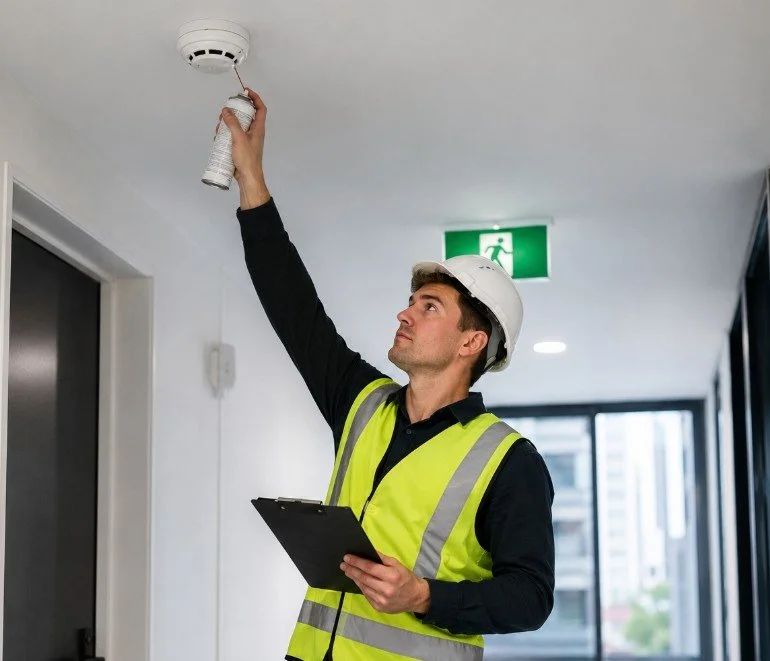
If you own or rent a strata apartment in Sydney, you've probably received a letter from the strata manager telling you an inspection is coming. You leave a key with the building manager, and a few hours later — nothing seems to have changed. So what actually happened? Having conducted fire safety assessments across Sydney's Inner West, the Northern Beaches, and out to Parramatta for over a decade, I can tell you that what happens during a fire safety inspection at a Sydney strata apartment is far more involved than most residents realise — and the consequences of getting it wrong have never been more serious. Here's everything you need to know.
The Legal Framework: Why These Inspections Are Mandatory in NSW
Fire safety inspections in NSW strata buildings aren't optional — they're a legal requirement under several overlapping pieces of legislation, and the framework has been significantly tightened in recent years. The regulatory changes are part of the NSW Environmental Planning and Assessment (EP&A) Regulation 2021, which sits alongside the Strata Schemes Management Act 2015. From 13 February 2026, all apartment buildings in NSW must have their essential fire safety systems inspected and tested regularly under the Australian Standard AS 1851, unless a performance solution is in place.
Compliance with AS 1851-2012, which provides a framework for inspecting, testing, and maintaining fire safety systems, is now mandatory (unless your building was built pre-July 1988). This is a big deal. From my experience, many strata committees have been operating under the assumption that periodic check-ups were enough. That era is over. In most cases, your strata building will also need a fire safety statement each year — this verifies that fire safety measures have been assessed and are working, such as fire sprinklers. In NSW, buildings that fall short of fire safety compliance strata requirements can face significant penalties, voided insurance claims, and increased risk of injury in the event of an emergency. The penalties are not trivial either: non-compliance can result in fines up to $66,000 for each instance of missed or delayed maintenance and further penalties for inadequate documentation.
Who Organises the Inspection and Who Shows Up?
One of the most common points of confusion I encounter — especially among newer strata owners — is understanding who is responsible for organising and who actually carries out the inspection. The strata manager or strata committee organises the fire safety statement, and the owners corporation delegates this to them. From there, the strata manager or strata committee appoints an accredited practitioner, who must have the right accreditation for the fire safety measures that need inspecting.
The person who walks into your building is an Accredited Practitioner (Fire Safety), or APFS. These aren't generalist tradies — they are specialists registered under the Fire Protection Association Australia (FPAA) accreditation scheme, and you can verify any practitioner's credentials on the FPAA register online. In my professional opinion, the accreditation check is something every strata committee should be doing before signing any contract.
Fire safety inspections are typically coordinated for the entire building, which includes many residents with varied schedules. Finding a time that suits everyone's needs can be challenging, especially since these inspections are often booked well in advance to ensure compliance with safety regulations. A red flag I always warn clients about: any quote that promises to do the inspection and issue a certificate on the same day is a red flag. A thorough inspection of a mid-rise Sydney strata block takes time — plan on a full day for a building of 30 or more lots.
Step-by-Step: What the Inspector Actually Checks
This is the heart of what happens during a fire safety inspection at a Sydney strata apartment, and it's broken into two broad categories: common property systems and in-lot checks. The fire safety schedule — the document that lists every essential fire safety measure (EFSM) specific to your building — is the inspector's bible for the day.
This includes things like exit signs, smoke alarms, fire extinguishers, fire-rated doors, emergency lighting in public areas, and perimeter access for emergency vehicles. But in practice, the inspection is far more granular than that list suggests. Here's what I've personally observed inspectors testing across hundreds of Sydney strata sites:
Smoke alarm and heat detector testing: Each device is triggered with aerosol test spray and its response time logged. Hardwired interconnected alarms — common in post-2000 Sydney builds — are tested to confirm the signal propagates building-wide.
Sprinkler head inspection: Inspectors visually check each sprinkler head for corrosion, paint overspray (a shockingly common defect I've seen in renovated units), and obstruction clearance. The system pressure is recorded against the hydraulic design data.
Fire hydrant and hose reel flow testing: Water pressure is tested at the most hydraulically disadvantaged outlet — typically the highest floor. I've seen buildings fail this test despite Sydney Water confirming adequate street pressure, because internal pipe corrosion was the culprit.
Fire-rated door integrity checks: The inspector checks door gaps, self-closing mechanisms, smoke seals, and latching function. A gap at the base exceeding 3mm is a common deficiency in older Inner West buildings.
Emergency and exit lighting: Each fitting is put into battery-discharge mode for a timed test. Fittings must maintain adequate illumination for 90 minutes under AS/NZS 2293.
Fire extinguisher condition and tagging: Pressure gauges, pin security, and last service date tags are verified. Extinguishers must be serviced in line with AS 1851.
Fire control panel and alarm system: The main panel is tested for fault conditions, zone isolation, and appropriate response to detector triggers. This often requires a licensed electrician to be present simultaneously.
Passive fire systems: Fire dampers in HVAC ductwork and fire collars around penetrations in fire-rated walls are inspected. This is the area I find most often neglected — some strata schemes have gone years without having dampers checked for compliance, resulting in remediation bills of up to $570,000.
Compliance with AS 1851-2012 requires strata schemes to follow specified routines for inspecting, testing and servicing essential fire safety measures — including alarms, sprinklers and emergency systems — with more frequent checks and detailed record-keeping.
Products and Equipment You'll See During the Inspection
Having worked alongside dozens of fire safety contractors, I've developed strong opinions about the gear being installed and tested in Sydney strata buildings. The quality of products matters enormously — a cheap smoke alarm that fails a test the first time an inspector touches it is a liability for the whole building.
For interconnected smoke alarms — the standard for most post-2000 Sydney apartment buildings — the market features brands including Clipsal, Red Smoke Alarms, Legrand, Brooks, Matelec, and PSA, offering various types including wired interconnect, wireless interconnect, battery-powered, photoelectric, and heat alarms. From my hands-on testing experience, the Clipsal photoelectric range → Clipsal photoelectric smoke alarm and Brooks BX-Series → Brooks BX-Series interconnected smoke alarm have consistently performed best in the field, with reliable sensitivity and low nuisance-alarm rates — a critical consideration in Sydney's coastal humidity. Smoke alarm units should be replaced every ten years, as smoke alarms have a designated "use by" date, and it is essential to replace them before that date to ensure the safety of your property and tenants.
For fire extinguishers, the most common type inspectors find — and test — in Sydney strata buildings is the ABE dry chemical powder extinguisher. ABE dry chemical extinguishers cover Class A (solids), Class B (liquids), and Class E (electrical). BE extinguishers cover only Class B and E. For most applications, ABE is the correct choice. Trusted brands in the Australian market include Wormald → Wormald ABE fire extinguisher and Chubb Fire & Security → Chubb ABE fire extinguisher. All models should comply with AS/NZS 1841, with prices starting from $26.90 for basic domestic units — though the 4.5kg ABE units standard in strata common areas typically retail in the $60–$120 AUD range depending on supplier. You can source these through trade suppliers like Reece, Tradeplus, or directly from manufacturer websites.
Emergency lighting units are another item inspectors scrutinise closely. In my experience, the Clevertronics Weathershield → Clevertronics emergency lighting unit series is widely specified by fire engineers on Sydney strata projects — they handle the coastal salt air common in suburbs like Manly, Cronulla, and Bondi far better than cheaper imports.
Common Defects Found — and Costly Mistakes to Avoid
After a decade in this industry, I've seen the same defects repeat across Sydney strata buildings of all ages and price points. Here's a comparison of the most common deficiency types, their typical remediation cost, and the urgency level under AS 1851 classification:
| Deficiency Type | Common Cause | Cost (AUD) | Urgency |
|---|---|---|---|
| Sprinkler head paint overspray | Unauthorised renovations | $80–$250 per head | High |
| Fire door gap/seal failure | Building settlement, age | $300–$1,200 per door | High |
| Emergency lighting battery failure | Age, heat degradation | $120–$400 per fitting | Medium |
| Fire damper not operational | Lack of maintenance | $500–$5,000+ per damper | Critical |
| Hydrant pressure inadequate | Pipe corrosion, pump failure | $5,000–$80,000+ | Critical |
| Smoke alarm expired | No replacement programme | $80–$200 per unit | Medium |
The single most costly mistake I see strata committees make is deferring defect rectification. If the fire safety practitioner finds that your building complies with all measures, they will sign the fire safety statement immediately. If your building needs any updates or repairs to comply fully, you have three months to carry out the works to ensure compliance with all fire safety measures. Three months sounds generous — until you're trying to source a specialist contractor for a 14-storey sprinkler system in a building where every floor is owner-occupied. Start the procurement process the day the defect report lands in your inbox.
Another mistake I see constantly: strata committees engaging the cheapest contractor without verifying credentials. It is a false economy to simply look for the cheapest quote if that does not cover all the work needed to inspect and rectify your fire safety measures.
After the Inspection: The Annual Fire Safety Statement Process
Once the physical inspection is complete and any defects are rectified, the paperwork process begins — and this is where many strata committees stumble. An Annual Fire Safety Statement (AFSS) confirms that fire safety measures in a building are operational and compliant with relevant standards. It is lodged annually with the local authority to demonstrate continuous compliance.
The certificate must be sent to the Commissioner of Fire & Rescue NSW (FRNSW) via email as well as to the local council, and a copy, along with the latest Fire Safety Schedule, must be displayed in a prominent location within the strata building. Owners Corporations must keep detailed records of fire safety inspections and maintenance for a minimum of seven years. These records must be available on-site, enabling prompt review by local authorities.
From my experience, the strata committee members who handle this process smoothly are those who have set up a digital compliance folder — ideally maintained by their strata manager — with each year's AFSS, the fire safety schedule, and all contractor service reports stored in chronological order. In the latest strata legislation changes, it is now a mandatory item on the agenda of each Annual General Meeting. The Owners Corporation must consider the Annual Fire Safety Statement obtained and determine the inspection and maintenance plan of the fire safety measures for the coming year. In professional opinion, this AGM agenda item deserves more than a two-minute rubber stamp — use it to genuinely review defect trends and budget for the year ahead.
The Emerging Threat: EV Batteries and Lithium Fire Risk in Strata
No article on Sydney strata fire safety in 2025–2026 would be complete without addressing the fastest-growing new risk on every fire consultant's radar: lithium-ion battery fires. This isn't a theoretical concern — it's something I'm being called about regularly by strata committees across Sydney's inner suburbs, particularly in buildings with basement carparks that weren't designed with EV charging in mind.
Electric vehicles (EVs) and lithium batteries are an emerging area of potential fire risk that authorities worldwide are gradually coming to grips with. Smaller lithium batteries used to recharge electric scooters have already triggered several strata fires, and owners corporations in NSW are considering bylaws to regulate or ban charging in units. The challenge with lithium battery fires is that they behave very differently from conventional fires — while there is no evidence that EVs create more fire risk than internal combustion engines, it is already well understood that traditional sprinkler or hydrant discharge will not extinguish or control this type of battery fire.
In my professional opinion, every Sydney strata building with basement carparking should be commissioning a specific EV and battery storage risk assessment as part of their next fire safety review — well ahead of the mandatory inspection cycle. FRNSW is actively working on effective strategies to minimise incidents related to emerging vehicle technologies and to ensure they will be able to respond effectively. Watch for FRNSW guidance updates in this space — they will likely inform NSW strata by-law templates within the next few years.
Disclaimer: The information in this article is general in nature and is not a substitute for professional legal or fire safety advice specific to your building. Always engage a licensed and accredited fire safety practitioner for formal compliance assessments. Regulatory details referenced are current as of publication but may change — refer to the NSW Government's Building Commission website and Fire and Rescue NSW for the most up-to-date requirements.
Frequently Asked Questions
How often must a fire safety inspection be carried out in a Sydney strata apartment building?
Most Sydney strata buildings must undergo an annual fire safety inspection to produce the Annual Fire Safety Statement (AFSS), which is submitted to the local council and Fire and Rescue NSW each year. However, under AS 1851-2012 — now mandatory in NSW as of 13 February 2026 — certain critical fire safety measures such as sprinkler systems and fire hydrants may require testing at more frequent intervals (monthly, quarterly, or six-monthly). Your building's fire safety schedule will specify the exact frequencies for each essential fire safety measure. Always refer to that document, not just the annual inspection cycle, to ensure full compliance.
Do inspectors need to enter my apartment, or is it just common areas?
This depends on what fire safety systems are installed within your individual lot. In many Sydney strata buildings, interconnected smoke alarms that form part of the building-wide fire detection system are located inside each apartment. In those cases, yes — the inspector will need access to your unit to test those devices. Strata committees are encouraged to communicate inspection dates well in advance and make arrangements for residents who cannot be present, such as leaving a key with the building manager or a trusted neighbour. Refusing access can result in the AFSS not being able to be issued, which is a compliance risk for the entire building.
What happens if defects are found during the inspection?
If the accredited fire safety practitioner identifies defects, the building owner (via the owners corporation) has up to three months to carry out rectification works before the AFSS can be issued. Critical defects — such as a failed fire hydrant system or a non-operational fire damper — must be prioritised immediately, as the AFSS cannot be signed off until these are resolved. The strata committee should obtain quotes from qualified contractors promptly and document all rectification activities. Failure to act can result in fines and, critically, can void the building's insurance coverage.
How much does a fire safety inspection typically cost for a Sydney strata building?
Costs vary significantly depending on building size, age, and complexity. For a small strata block of 8–12 units with basic fire safety measures, you might expect to pay anywhere from $800 to $2,500 AUD for a comprehensive annual inspection and AFSS preparation. Larger or more complex buildings — those with sprinkler systems, hydrants, fire control rooms, and extensive passive fire elements — can attract fees of $5,000 to $15,000 or more. Smoke alarm compliance services for individual lot owners are available from specialist providers starting around $99 AUD per lot. Always get at least two or three quotes from FPAA-accredited practitioners and scrutinise what is and isn't included in the scope.
Stay Compliant, Stay Safe: Your Next Steps
A fire safety inspection at a Sydney strata apartment is not a box-ticking formality — it is the mechanism that keeps the people inside your building alive in an emergency. From passive systems like fire doors and dampers to active systems like sprinklers and alarms, every element plays a role in buying residents the critical minutes they need to evacuate safely. In a 2021 report, Fire & Rescue NSW revealed they respond to over 500 fires within residential apartments or units each year. Your building's compliance record could be the difference between a contained incident and a catastrophe. If you're a strata committee member, review your fire safety schedule today, confirm your practitioner's FPAA accreditation, and make fire safety a genuine agenda item at your next AGM — not just a line item. If you'd like a personalised fire safety review for your strata scheme, get in touch with an accredited fire safety consultant in your area through the FPAA practitioner register at fpaa.com.au.